Walk into any paint shop in Muscat — whether it is a Jotun stockist in Al Khuwair, a Dulux supplier in Seeb, or a hardware store in Sohar’s industrial area — and you will find the shelves divided clearly into interior paints and exterior paints. The price difference between the two categories is noticeable. The technical specifications on the tins look different. The salesperson will strongly advise you to use the right type for the right surface.
But why exactly does it matter? Can you use interior paint on an outside wall to save money? Can exterior paint be used indoors for a tougher finish in a high-traffic area? And what makes Oman’s climate — with its extreme heat, UV intensity, dust, humidity, and occasional heavy rains — so particularly demanding on painted surfaces compared to other parts of the world?
These are questions that homeowners across Muscat, Sohar, Nizwa, Ibra, and every corner of the Sultanate ask regularly when planning a painting project. The answers matter not just for the aesthetics of your home but for your budget — because using the wrong paint type in Oman’s conditions leads to premature failure, expensive repainting, and in some cases structural surface damage that goes well beyond the paint itself.
This guide explains everything you need to know about the difference between interior and exterior paint in Oman — what is in each type of paint, why those ingredients matter in the Omani climate, what happens when you use the wrong type, and how to choose the right paint and finish for every surface in your home or building across Muscat and Oman.
THE FUNDAMENTAL DIFFERENCE — WHAT IS ACTUALLY IN THE TIN
To understand why interior and exterior paints behave so differently, it helps to understand what they are actually made of — and why the formulations differ so significantly.
All paints share the same basic components — a pigment that provides colour, a binder that holds the pigment to the surface and gives the film its properties, a solvent or carrier that makes the paint liquid enough to apply, and various additives that modify specific performance characteristics.
The critical differences between interior and exterior paint lie in the binder chemistry and the additive package — the ingredients that determine how the paint film performs over time under the specific conditions it faces.
The Binder — The Most Important Ingredient
The binder in a paint film is what actually adheres to the surface and forms the protective coating. Interior and exterior paints use different binder formulations because the challenges they face are completely different.
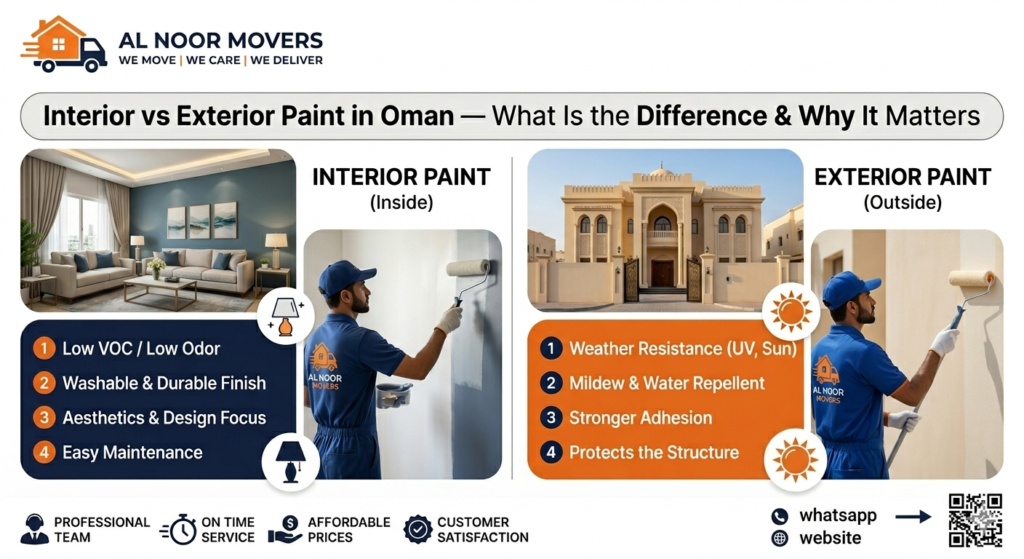
Interior paint binders are formulated primarily for washability, stain resistance, colour retention under artificial lighting, and low odour. They create a relatively hard, smooth film that resists scuffing, cleaning, and everyday household contact. Interior binders do not need to flex significantly or resist UV degradation because they are not exposed to these stresses.
Exterior paint binders are formulated for flexibility, UV resistance, and weather resistance. They remain slightly more flexible than interior binders — a critical property in Oman’s climate where painted surfaces expand and contract significantly with temperature changes from 15°C winter nights to 50°C summer days. A rigid paint film that cannot flex with this movement cracks and peels. An exterior binder also contains UV stabilisers — compounds that absorb or reflect ultraviolet radiation and prevent the molecular breakdown that causes fading and chalking.
The Additives Package
Beyond the binder, exterior paints contain a significantly more complex additives package than interior paints. In the context of Oman’s climate, the most important of these are:
UV absorbers and light stabilisers — these are present in exterior paint in much higher concentrations than in interior paint. In Oman, UV radiation levels are among the highest in the world for extended periods. Without adequate UV protection a painted exterior surface in Muscat can begin fading and chalking within a single summer.
Mould and algae inhibitors (biocides) — exterior paints contain biocide additives that inhibit the growth of mould, algae, and fungal colonies on painted surfaces. In Muscat’s coastal areas — Al Mouj, Muttrah, Quriyat — and in humid interior areas like Salalah, moisture-driven biological growth on exterior walls is a genuine problem that biocide-containing exterior paints are specifically formulated to address. Interior paints also contain some mould resistance for bathrooms and kitchens, but at lower concentrations.
Dirt and dust release agents — exterior paints in Gulf formulations often contain additives that make the surface less receptive to dust adhesion and easier to clean with rainwater or a simple hose-down. This is a specific response to the high dust levels in Oman’s environment — particularly relevant in Muscat’s inland areas like Nizwa and Ibra where dust accumulation on walls is rapid.
Elastomeric properties — some exterior paints formulated for Gulf climates contain elastomeric compounds that allow the paint film to bridge small cracks in rendered surfaces — a particularly valuable property in Oman where the thermal expansion and contraction of masonry walls creates hairline cracks over time.
WHY OMAN’S CLIMATE MAKES THE DISTINCTION CRITICAL
The difference between using the right and wrong paint type matters in any climate. In Oman it matters enormously — because the conditions here push paint systems harder than almost anywhere else in the world.
Extreme UV Radiation
Oman sits between latitudes 16° and 26° north — very close to the equator by global standards — and receives intense, near-vertical solar radiation for the majority of the year. The UV index in Muscat regularly reaches 11 to 12 — classified as extreme — during peak summer months. This UV intensity causes photodegradation in paint films that lack adequate UV stabilisers, leading to rapid colour fading, chalking of the surface, and breakdown of the binder that holds the paint film together.
Interior paint used on an exterior wall in Muscat will begin to chalk, fade, and lose adhesion within one summer — often within three to four months of application. The UV stabilisers in a quality exterior paint formulated for Gulf conditions — Jotashield, Dulux Weathershield, Berger WeatherCoat — are specifically designed to withstand this UV load and maintain film integrity for five to eight years.
Temperature Extremes and Thermal Cycling
In Muscat, painted exterior surfaces regularly experience temperatures from below 20°C on winter nights to above 55°C on west-facing walls in peak summer afternoon sun. This is a temperature swing of 35°C or more — and it happens every single day, creating a cycle of expansion and contraction that puts enormous mechanical stress on any coating applied to the surface.
Interior paint films are formulated to be relatively rigid — ideal for smooth, stable interior walls that do not experience significant temperature movement. On an exterior wall in Oman this rigid film cracks, flakes, and peels within months as the substrate moves and the paint cannot flex with it. Exterior paint’s more flexible binder allows it to accommodate this movement without cracking.
This thermal cycling effect is particularly severe in specific areas. In Muscat, west-facing walls in exposed locations — common in villa developments in Seeb, Bousher, and Al Maabilah — receive the most intense late afternoon solar radiation and experience the most extreme surface temperatures. These surfaces require the highest quality exterior paint systems to achieve acceptable longevity.
Dust and Sand
Oman’s environment subjects exterior painted surfaces to constant dust and sand abrasion — particularly during shamal winds that carry fine sand particles at high velocity. Inferior exterior paints and any interior paint used outdoors suffer accelerated surface erosion from this abrasion, creating a rough, chalky surface that traps further dust and eventually loses its protective function.
In Muscat’s dustier inland suburbs — Al Maabilah, Halban, Al Rusayl — and in cities like Nizwa and Ibra where dust accumulation from the surrounding desert is heavier, this abrasion effect is more pronounced than in coastal Muscat neighbourhoods. Exterior paints with harder surface films and dust-release additives specifically address this challenge.
Coastal Humidity and Salt Air
Muscat is a coastal city and many of its most desirable residential areas — Al Mouj, Shatti Al Qurum, Muttrah, the waterfront areas of Muscat Bay — are directly exposed to marine air carrying moisture and salt. Salt-laden air is significantly more corrosive to painted surfaces than standard inland air. It penetrates paint films, promotes blistering, and accelerates the corrosion of any metal elements in a wall assembly.
Sohar faces similar conditions on its coastal side, as does Quriyat to the east of Muscat. Interior paint on exterior walls in these locations fails faster than almost anywhere else in Oman — the combination of UV, salt air, and humidity creates an exceptionally aggressive environment for any inadequate coating.
Seasonal Rains
While Oman is predominantly arid, Muscat receives periodic heavy rainfall — sometimes intense and sudden — particularly from the khareef conditions that occasionally affect the northeast coast, and from winter shamal-associated weather systems. These rainfall events subject exterior walls to water impact, saturation, and rapid drying cycles that interior paint films are completely unable to handle. Blistering, peeling, and efflorescence — the white salt deposits that appear on walls after water penetration — are common consequences of inadequate exterior paint in Oman.
WHAT HAPPENS WHEN YOU USE INTERIOR PAINT OUTDOORS IN OMAN
This is the question homeowners most often face when tempted to use leftover interior paint on an exterior surface, or when an unscrupulous contractor uses cheaper interior paint for an exterior job.
The consequences in Oman’s climate are predictable and expensive.
Within Three to Six Months
The UV radiation begins breaking down the interior paint binder. The surface starts to chalk — running your hand across it leaves a white powder residue. Colours begin fading noticeably, particularly on south and west-facing walls that receive the most direct sun. The surface loses its sheen and begins to look tired and dull.
In Muscat, this process is visible on walls painted with the wrong product by the end of the first summer. Homeowners in Al Ghubra, Azaiba, and the exposed western suburbs of Seeb who have had interior paint mistakenly applied to exterior walls often call for repainting within six months — having paid for a job that should have lasted five to seven years.
Within Six to Twelve Months
The paint film begins to crack and peel as thermal cycling stress overcomes the rigid interior binder’s ability to flex. In Oman’s temperature extremes this cracking can be rapid and extensive — long diagonal cracks following the render joints beneath, circular blistering where moisture has penetrated behind the film, and large sections peeling away from the wall surface entirely.
Once the film cracks and peels it loses its protective function entirely. The underlying render is now exposed to water penetration, UV degradation, and carbonation — processes that damage the render itself and eventually the masonry beneath.
The Cost Consequence
Repainting an exterior that has failed prematurely due to wrong paint selection costs exactly as much as doing it correctly the first time — plus the additional cost of surface preparation to remove the failed paint and repair any render damage it has caused. Using cheap interior paint on an exterior surface in Oman never saves money. It reliably costs more.
WHAT HAPPENS WHEN YOU USE EXTERIOR PAINT INDOORS IN OMAN
The reverse question — can you use exterior paint indoors for a tougher finish — is less common but worth addressing.
It Is Possible but Not Recommended
Exterior paint will adhere to interior walls and will be more durable in some respects — harder wearing and more moisture resistant. However using exterior paint indoors in Oman creates specific problems.
VOC emissions. Exterior paints contain higher levels of volatile organic compounds — the chemicals that allow them to cure and develop their weather-resistant properties. Outdoors these VOCs disperse rapidly. Indoors in an air-conditioned Omani home they remain trapped, creating poor indoor air quality, strong persistent odour, and potential health effects particularly for children, elderly residents, and anyone with respiratory conditions. This is a significant concern in Oman where windows remain closed and AC runs continuously for months.
Appearance. Exterior paint does not achieve the same smooth, even finish indoors that a quality interior paint provides. The harder, more textured surface of exterior paint shows brush and roller marks more visibly, does not burnish as smoothly, and often appears less refined on interior walls.
Unnecessarily expensive. Exterior paint costs significantly more than interior paint. Using it indoors provides no meaningful benefit over a good quality interior paint in the conditions an interior wall faces — while costing more and creating indoor air quality issues.
The one exception: Bathrooms and kitchens in properties with persistent damp or mould problems sometimes benefit from a moisture-resistant exterior-grade product on specific walls. This should be a deliberate choice made with professional advice — not a general approach.
INTERIOR PAINT IN OMAN — WHAT TO LOOK FOR
Understanding what makes a good interior paint in Oman’s specific conditions helps you choose wisely among the many options available in Muscat’s paint shops.
Washability and Scuff Resistance
In a climate where AC runs continuously and windows stay closed, interior walls accumulate fingerprints, marks, and scuffs faster than in ventilated homes. A washable interior paint — eggshell or soft sheen finish — that can be wiped clean with a damp cloth is far more practical for living areas, hallways, and children’s rooms in Muscat homes than a flat matt finish that marks easily.
Mould and Humidity Resistance for Specific Areas
Muscat bathrooms and kitchens — particularly in older villa properties and apartments where ventilation is limited — can develop mould on walls. Choose an interior paint with specific anti-mould additives for these areas. Jotun Lady Anti-Mould, Dulux Bathroom Plus, and similar formulations are available in Muscat paint stockists and significantly outperform standard interior paint in wet areas.
Low VOC for Health and Comfort
With AC running continuously and limited fresh air circulation in most Omani homes, interior paint VOC levels matter more here than in naturally ventilated buildings. Low-VOC or zero-VOC interior paints are available from all major brands in Oman and are strongly recommended for bedrooms, children’s rooms, and any space occupied continuously. Jotun Lady Pure Colour, Dulux EasyCare, and Nippon Paint Odour-Less are among the options available in Muscat.
Colour Stability Under Artificial Light
In an Omani home where occupants spend significant time indoors under artificial lighting — particularly during hot summer months — choosing interior paint that was tested under both natural and artificial light conditions matters. Warm-toned artificial lighting common in Omani homes shifts colour perception significantly. Test paint colours in your actual room under both daytime and evening lighting before committing.
EXTERIOR PAINT IN OMAN — WHAT TO LOOK FOR
For any exterior painting project in Muscat, Sohar, Nizwa, Ibra, or anywhere across the Sultanate, these are the properties that matter most.
UV Resistance — Non-Negotiable in Oman
Every exterior paint used in Oman must carry a UV resistance rating appropriate for Gulf climate conditions. Look for products specifically marketed for Gulf, Middle East, or tropical climates — these formulations contain UV absorbers and light stabilisers in concentrations appropriate for Oman’s radiation levels. Standard exterior paints formulated for European climates are inadequate.
Jotashield Extreme, Dulux Weathershield Maximum, and Berger WeatherCoat are among the formulations specifically developed for Gulf exterior conditions and widely available in Muscat and across Oman.
Elastomeric or Flexible Film for Thermal Movement
Given the extreme thermal cycling of Omani exterior walls, a paint with an elastomeric or flexible film binder is strongly recommended for exposed exterior surfaces — particularly on large unshaded walls, west-facing facades, and rooftop parapets. These paints can bridge hairline cracks that form from thermal movement rather than cracking with them.
This property is particularly important in Sohar’s industrial area and in Nizwa and Ibra’s inland locations where temperature extremes are more pronounced than on Muscat’s coast.
Dirt and Algae Resistance for Muscat’s Environment
In coastal Muscat areas — particularly the stretch from Muttrah through Qurum to Al Ghubra — biological growth on exterior walls is a genuine issue. Choose exterior paints with biocide additives and dirt-release surface properties. Self-cleaning exterior paints — where a photocatalytic or hydrophobic surface causes rain and dew to wash away surface contamination — are now available from Jotun and Dulux in Oman and are worth considering for accessible exterior walls.
Heat-Reflective Formulations for Energy Efficiency
An increasingly available category of exterior paint in Oman uses special pigments that reflect near-infrared solar radiation — a significant portion of the heat load from sunlight — rather than absorbing it. These heat-reflective exterior paints can reduce exterior wall surface temperatures by 5°C to 15°C compared to standard exterior paint of the same colour, reducing heat transfer into the building and lowering cooling costs.
In Oman where cooling represents one of the largest household energy costs, a heat-reflective exterior paint on south and west-facing walls represents a genuinely cost-effective upgrade. Jotun’s CoolStar range and Dulux’s AcraTex Coolseal are examples available in Oman.
LOCATION-SPECIFIC GUIDANCE ACROSS OMAN
Different cities and areas in Oman present slightly different painting challenges based on their specific environmental conditions.
Muscat — Coastal UV and Marine Air
Muscat’s combination of extreme UV, coastal humidity, salt air, and periodic heavy rainfall makes it one of the most demanding exterior painting environments in Oman. Properties in coastal Muscat areas — Al Mouj, Shatti Al Qurum, Muttrah, Muscat Bay, Quriyat — face the additional challenge of marine salt aerosol that penetrates standard paint films and causes blistering and corrosion.
Recommendation for Muscat exteriors: Use only premium exterior grade paint specifically rated for Gulf conditions with biocide additives and UV protection. For beachfront or waterfront properties in Muscat, consider a masonry primer with salt-resistant properties before the topcoat. Jotashield or Dulux Weathershield Maximum with a Jotun Jotaplast primer system is a well-proven specification for Muscat coastal exteriors.
For Muscat interiors: Standard premium interior paint is adequate. For bathrooms and kitchens in older Muscat apartments and villas — particularly those in Ruwi, Muttrah, and older Al Khuwair developments — specify anti-mould interior paint.
Sohar — Industrial Dust and Coastal Combination
Sohar presents a dual challenge — the coastal humidity and salt air of its waterfront areas combined with the heavy industrial dust from the Sohar Industrial Port City. Exterior painted surfaces in Sohar accumulate dust significantly faster than in Muscat’s residential areas, and the combination of salt air and industrial particulates is more corrosive than either alone.
Recommendation for Sohar exteriors: Exterior paint with strong dirt-release properties and biocide additives. For properties in or near the industrial area, consider a thicker film application or an elastomeric exterior coating that is more resistant to the abrasive dust load. Self-cleaning exterior paint formulations are particularly practical in Sohar given the rapid dust accumulation.
For Sohar interiors: Standard premium interior paint. For accommodation near the industrial area where dust penetration is higher, consider a harder eggshell finish rather than matt that is easier to wipe clean.
Nizwa — Extreme Heat and Desert Dust
Nizwa sits inland in the Ad Dakhiliyah Governorate and experiences some of the most extreme temperature ranges in Oman — very hot summers with temperatures above 45°C regularly, combined with cooler winter nights than coastal areas. The thermal cycling stress on exterior paint in Nizwa is more severe than in Muscat. Desert dust accumulation is heavier and the UV load is unmoderated by coastal haze.
Recommendation for Nizwa exteriors: Elastomeric exterior paint is particularly recommended for Nizwa given the extreme thermal cycling. Heat-reflective formulations also offer meaningful energy savings in Nizwa’s intense summer heat. Light colours are more important here than anywhere else in Oman for managing heat absorption.
For Nizwa interiors: Low-VOC interior paint is important in Nizwa where windows are kept closed for even more of the year than in coastal Muscat due to dust. Anti-mould additives are less critical than in coastal areas but still recommended for bathrooms and kitchens.
Ibra — Dust and Occasional Humidity
Ibra in Ash Sharqiyah North Governorate experiences high dust levels from the surrounding desert combined with occasional humidity events. Exterior surfaces in Ibra accumulate dust rapidly and benefit from dirt-release exterior paint formulations. The UV load is intense and unmoderated by coastal conditions.
Recommendation for Ibra exteriors: UV-resistant exterior paint with dust-release properties. Light exterior colours are strongly recommended to manage heat absorption in Ibra’s exposed desert setting.
For Ibra interiors: Standard premium interior paint. Low-VOC formulations recommended for continuously air-conditioned spaces.
Salalah — Khareef Humidity
Salalah in Dhofar Governorate presents a unique challenge in Oman — the khareef monsoon season brings weeks of persistent mist, high humidity, and direct rainfall that is unlike anything experienced in northern Oman. Exterior painted surfaces in Salalah are subject to significantly more moisture than anywhere else in the Sultanate.
Recommendation for Salalah exteriors: Biocide-containing exterior paint with strong water resistance and mould inhibition is essential. Elastomeric coatings that prevent water penetration through minor surface cracks are particularly valuable in Salalah’s wet season. Algae and mould growth on exterior walls is a major issue in Salalah — biocide additives are non-negotiable.
For Salalah interiors: Anti-mould interior paint is strongly recommended for all rooms in Salalah — not just bathrooms and kitchens. The khareef humidity penetrates buildings even with AC running and mould growth on interior walls is a common problem in inadequately painted Salalah homes.
FINISH GUIDE — WHICH SHEEN LEVEL FOR WHICH SURFACE IN OMAN
Choosing the right finish — the level of sheen in the paint film — is as important as choosing the right paint type. Here is a straightforward guide for Omani homes.
Interior Finishes
Matt / Flat Zero or near-zero sheen. Hides surface imperfections well, looks sophisticated and contemporary. Marks easily and is difficult to clean without removing paint. Best for: bedroom walls, formal living rooms, ceilings, low-traffic areas.
Soft Sheen / Eggshell Low sheen — slight gloss visible in raking light. More washable than matt, good durability. The most versatile interior finish. Best for: living rooms, hallways, children’s rooms, dining rooms — anywhere that needs to look good and be cleanable.
Satin Medium sheen. Noticeably reflective. Very washable and durable. Can highlight wall imperfections. Best for: kitchens, utility rooms, high-traffic corridors, children’s rooms where maximum washability is needed.
Semi-Gloss High sheen. Very washable and moisture-resistant. Highlights every surface imperfection. Best for: interior woodwork, door frames, skirting boards, window reveals, kitchen and bathroom cabinetry.
Gloss Maximum sheen. Extremely durable and washable. Must be applied over perfectly prepared surfaces or every imperfection is amplified. Best for: interior doors, exterior-facing woodwork, metal railings.
Exterior Finishes
Flat / Matt Exterior Low sheen exterior finish. Hides render imperfections. Less cleanable than sheen finishes. Best for: rough textured exterior render, feature walls, areas not subject to heavy rain splash-back.
Low Sheen / Soft Sheen Exterior The most practical exterior finish for most Omani walls. More cleanable than flat, does not highlight render imperfections as much as higher sheen finishes. Best for: the majority of exterior rendered walls across Muscat, Sohar, Nizwa, and Oman.
Gloss Exterior High sheen for exterior surfaces. Reserved for metalwork, exterior doors, window frames, and ironwork where maximum durability and easy cleaning are priorities. Not suitable for large rendered exterior walls — creates blinding reflections in Oman’s intense sunlight and highlights every surface imperfection.
PAINT BRANDS IN OMAN — INTERIOR VS EXTERIOR PRODUCT LINES
Here is a quick reference guide to the main interior and exterior paint products available from leading brands across Muscat and Oman.
Jotun — Most Widely Available in Oman
Interior: Jotun Lady Supreme (premium), Jotun Lady Pure Colour (low VOC), Jotun Lady Anti-Mould (wet areas), Jotun Jotaplast (economy interior)
Exterior: Jotashield Extreme (premium Gulf exterior), Jotun Jotashield Antifade (colour retention), Jotun CoolStar (heat reflective), Jotun Jotaplast Exterior (economy)
Available in Muscat at: Jotun stockists in Al Khuwair, Seeb, Qurum, and through hardware stores across Oman including Sohar, Nizwa, and Ibra.
Dulux — Strong Presence Across Oman
Interior: Dulux EasyCare (washable), Dulux Bathroom Plus (moisture resistant), Dulux Ceiling White, Dulux Trade Diamond Matt (commercial)
Exterior: Dulux Weathershield Maximum (premium Gulf exterior), Dulux Weathershield Smooth (standard exterior), Dulux Weathershield Textured (decorative exterior)
Available in Muscat at: Dulux stockists in Ruwi, Al Khuwair, and major hardware suppliers across Muscat and key Oman cities.
Berger — Good Value Gulf Formulations
Interior: Berger Breatheasy (low VOC), Berger Silk (washable interior), Berger Damp Shield (moisture resistant)
Exterior: Berger WeatherCoat (Gulf exterior), Berger Weatherproof Smooth, Berger Masonry Paint
Available across: Muscat, Sohar, Nizwa hardware and paint suppliers.
Nippon Paint — Growing Availability in Oman
Interior: Nippon Paint Odour-Less (low VOC), Nippon Paint Momento (premium), Nippon Paint Vinilex (economy)
Exterior: Nippon Paint Weatherbond (exterior), Nippon Paint Aquaseal (waterproof exterior)
COMMON MISTAKES OMANI HOMEOWNERS MAKE WITH PAINT SELECTION
These are the most frequently seen paint selection errors across painting projects in Muscat, Sohar, Nizwa, and across Oman — and how to avoid them.
Using the same paint for inside and outside. The most expensive mistake. In Oman’s climate the consequences are rapid and costly as described above. Always use the correct type for each surface.
Choosing exterior paint based on colour alone without checking UV rating. Two exterior paints can look identical in the tin and have completely different UV resistance. Always check that the product is rated for Gulf or tropical exterior conditions — not just standard European exterior use.
Using matt finish in bathrooms and kitchens. Matt paint in a bathroom in Oman absorbs moisture, is impossible to clean properly, and develops mould behind the film. Always use eggshell or higher in wet areas and specify anti-mould formulation.
Skipping primer on new render. Fresh render in Oman is highly alkaline — particularly in the first three to six months after application. Applying paint directly to unprimed fresh render causes saponification — a chemical reaction that destroys the paint film from beneath. Always use an alkali-resistant primer on new render before painting. This mistake is seen regularly on new villa constructions in developing areas of Muscat like Al Maabilah and Halban.
Applying exterior paint in peak summer heat. Painting exterior walls in Muscat when surface temperature exceeds 40°C — common from May to September on sun-facing walls — causes the solvent to evaporate too quickly, preventing proper film formation. Paint in early morning before 9am or in the evening after 5pm during summer months. Or better still, schedule exterior painting in October through March when temperatures are more suitable.
Choosing dark exterior colours without understanding heat consequences. A deep charcoal or dark brown exterior wall in Muscat can reach surface temperatures above 70°C in peak summer. Beyond the energy implications, these surface temperatures significantly reduce paint longevity — even the best exterior paint ages faster at 70°C than at 50°C. If dark exterior colours are desired, use only heat-reflective formulations with near-infrared reflecting pigments.
WHEN TO USE A PROFESSIONAL PAINTING COMPANY IN OMAN
Understanding the difference between interior and exterior paint is only part of the equation. Even the most carefully chosen paint system delivers disappointing results when surface preparation is inadequate or application technique is poor.
This is particularly true in Oman where specific preparation steps — filling hairline cracks from thermal movement, applying alkali-resistant primer on fresh render, using the correct primer for different substrate types — are regularly skipped by inexperienced painters to save time and reduce costs.
Professional house painters in Muscat and across Oman who understand the local conditions bring three things that make a meaningful difference to the outcome and longevity of your paint project.
Correct surface preparation. Filling cracks, sanding, cleaning, and priming correctly for the specific substrate and paint system being applied. This is what separates a paint job that lasts five years from one that peels within twelve months on an Omani exterior wall.
Product knowledge for local conditions. Understanding which Jotun, Dulux, or Berger product is appropriate for a coastal Muscat exterior versus an inland Nizwa wall versus a Sohar industrial area property. Knowing which finishes work in Oman’s light and which disappoint. This knowledge comes from experience of painting in these conditions.
Correct application in Oman’s climate. Knowing when not to paint — avoiding peak heat in summer, avoiding high humidity periods in coastal areas, timing coats correctly for the temperature and humidity conditions of the day. Incorrect application timing is one of the most common causes of exterior paint failure in Oman.
Al Noor Movers provides professional house painting services across Muscat, Sohar, Nizwa, Ibra, and across Oman — interior and exterior, all property types, using only appropriate premium paint systems for each surface and location. Every project includes a free colour and product consultation so you can be confident the right paint type, grade, and finish is being used for every surface in your home.
CONCLUSION
The difference between interior and exterior paint in Oman is not a marketing distinction — it is a fundamental difference in chemistry, performance, and longevity that matters enormously in one of the world’s most demanding climates for painted surfaces.
Interior paint used outdoors in Muscat fails within months. Exterior paint used indoors creates indoor air quality problems and costs more than necessary. Using the correct paint type for each surface — combined with proper surface preparation, appropriate primers, and correct application timing — is what determines whether your paint job looks excellent for five to seven years or requires expensive repainting within one.
Across Muscat’s coastal villas, Sohar’s industrial compounds, Nizwa’s heat-exposed homes, and Ibra’s dust-laden properties — the principles are the same. Match the paint to the surface, the environment, and the conditions. Use quality products from brands with Gulf-specific formulations. Prepare surfaces correctly. Apply in suitable conditions.
If you are planning a painting project anywhere in Oman and want the confidence of knowing the right products are being used and applied correctly — Al Noor Movers is here to help. Call us today for a free consultation and quote for your interior or exterior painting project in Muscat or across Oman.
📞Planning a Painting Project in Muscat or Oman?
Al Noor Movers provides professional interior and exterior painting services across Muscat, Sohar, Nizwa, Ibra, and Oman. Free colour and product consultation, premium paints, guaranteed finish.
Visit us at: www.alnoormovers.com | Call: +968 9294 2088