
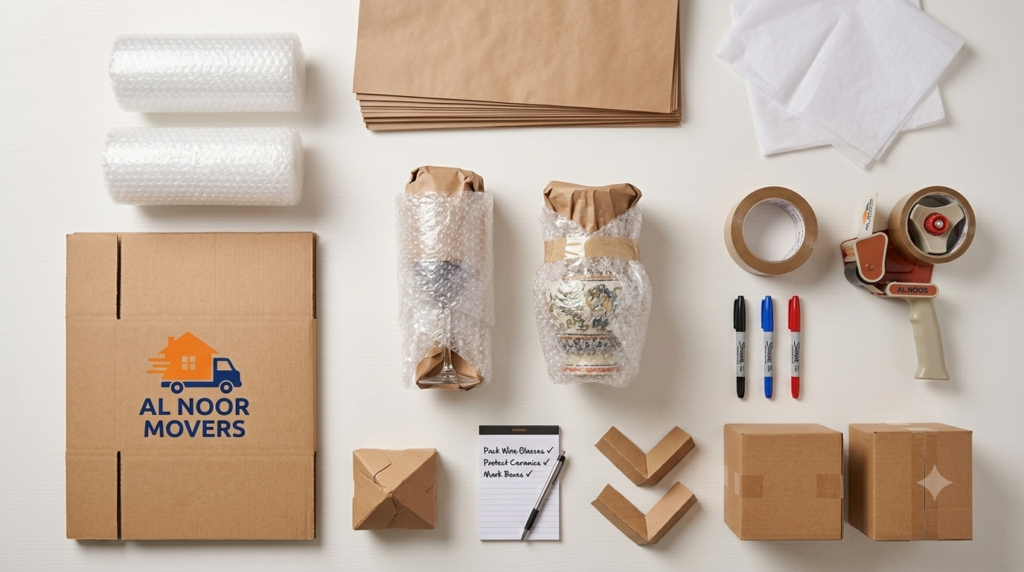
Moving house in Muscat is stressful enough without the added anxiety of wondering whether your fragile items will survive the journey. The crystal glasses your family brought from abroad. The decorative ceramics collected across years of travel. The large mirror that hangs in your entrance hall. The television and the artwork. The fine china that only comes out for special occasions. These are not just objects — they are investments, memories, and irreplaceable pieces of your home that deserve to arrive at your new Muscat property in exactly the condition they left the old one.
The good news is that packing fragile items for moving in Oman is not complicated — but it does require the right materials, the right techniques, and the right approach to box selection, layering, and labelling. The difference between fragile items that arrive safely and those that arrive damaged almost always comes down to preparation and method, not luck.
This guide gives you expert packing tips for every category of fragile item commonly moved in Muscat houses and villas — glassware and crockery, mirrors and artwork, electronics, furniture with glass panels, decorative ceramics, and more. Every tip in this guide comes from years of professional moving experience across Muscat, Sohar, Nizwa, Ibra, and the wider Sultanate — the specific conditions of Oman’s climate, the road surfaces, and the typical Muscat villa layout all influence how fragile items should be packed for safety in transit.
Work through this guide before your moving day and your fragile items will arrive at your new Muscat home safely — every single one.
WHY PACKING FRAGILE ITEMS IN OMAN REQUIRES EXTRA CARE
Before getting into the specific techniques, understanding what makes packing fragile items for moving in Oman specifically challenging helps motivate the care that every technique requires.
Heat Exposure During Loading and Transit
Muscat’s summer heat — and the elevated temperatures of the spring and autumn transition months — creates a genuine risk for fragile items during the loading and transit phases of a house move. Electronics, candles, certain adhesives used in decorative items, and materials like lacquer and shellac on antique furniture can all be damaged by the temperatures inside a moving truck that has been sitting in the Muscat sun.
A properly packed fragile item — insulated within layers of paper and bubble wrap inside a well-structured box — is significantly more protected from temperature extremes than an item loosely placed in a box with minimal padding. The insulating properties of good packing materials are not just about cushioning impact — in Oman’s climate they also provide meaningful temperature buffering during transit.
Road Conditions on Muscat’s Streets
Muscat’s road network — while generally well-maintained on the main highways — includes many older residential streets in areas like Ruwi, Muttrah, Old Muscat, and parts of Al Seeb with uneven surfaces, speed bumps, and narrow lanes that require slow, stop-start vehicle movement. This stop-start motion creates repeated small shocks to the cargo rather than the single sustained vibration of a smooth highway journey. Fragile items packed to withstand highway transit can be damaged by the repeated impact of urban stop-start driving if packing is inadequate.
Intercity Moves Add Transit Time and Distance
For families moving from Muscat to Sohar, Nizwa, or Ibra — or within the wider Sultanate — fragile items spend significantly more time in transit than in a local Muscat move. The 220-kilometre journey from Muscat to Sohar, for example, involves two to three hours of truck movement including a major highway section and urban road driving at both ends. Every additional minute of transit time increases the opportunity for movement and impact within the truck — making thorough packing even more important for intercity moves in Oman.
Muscat Villas Often Have Multiple Floors and Narrow Stairs
Many Muscat villas have upper floors accessed by interior staircases — and the staircase in an older Muscat villa can be narrow, steeply angled, and difficult to navigate with large or awkward items. Fragile items being carried up and down stairs are subject to tilting, rotation, and the kind of handling that only well-packed items survive without damage.
THE RIGHT PACKING MATERIALS FOR MOVING IN MUSCAT
Before starting to pack, having the right materials available is essential. Using the wrong materials — newspaper ink that transfers to your best china, thin plastic bags instead of bubble wrap, undersized boxes that cannot fit your items safely — is one of the most common causes of packing failures on Muscat house moves.
Packing Paper — Your Most Important Material
Packing paper — unprinted newsprint — is the foundation of fragile item packing. It is flexible enough to wrap around irregular shapes, absorbent enough to cushion light impacts, and soft enough to protect delicate surfaces without scratching. Use it generously — three to five sheets per piece of crockery, multiple layers around glass items, and crumpled balls of paper to fill every void in a packed box.
What not to use instead of packing paper: Printed newspaper is not a substitute — the ink transfers to china, glass, and light-coloured surfaces and is very difficult to remove. Tissue paper alone is too thin and fragile. Plain paper from a printer is too stiff to wrap properly around curves.
Where to get packing paper in Muscat: Stationery and packaging suppliers across Muscat sell plain newsprint paper. Some moving companies in Oman supply packing paper as part of their full packing service. Hardware stores across Muscat and Sohar stock basic packing materials.
Bubble Wrap — Essential for Medium and High-Value Fragile Items
Bubble wrap provides the cushioning that packing paper alone cannot — the air-filled bubbles absorb impact energy that would otherwise be transmitted to the fragile item inside. Use bubble wrap as the primary wrap for glassware, ceramics, mirrors, artwork, and electronics before outer wrapping in packing paper.
Choosing the right bubble wrap for Muscat moves:
Large-bubble wrap (approximately 25mm bubble diameter) provides better cushioning for larger items — mirrors, framed artwork, large decorative pieces. Small-bubble wrap (approximately 10mm bubbles) is better for smaller fragile items — wine glasses, individual ceramic pieces, figurines — where large bubbles create too uneven a surface against the item.
Where to get bubble wrap in Muscat: Packaging suppliers in Al Khuwair, Seeb industrial area, and Ruwi stock bubble wrap in rolls and sheets. Major hardware stores across Muscat carry basic bubble wrap. Order in advance if you need significant quantities — running out mid-packing is a common problem.
Moving Boxes — Size Selection Matters Enormously
The single biggest packing mistake on Muscat house moves is using the wrong box size. Very large boxes packed with heavy fragile items — like all the kitchen crockery in one oversized box — are too heavy to carry safely, flex under their own weight, and concentrate too many fragile items in one vulnerable container.
The right boxes for fragile items:
Small boxes — approximately 30cm x 30cm x 30cm — are ideal for heavy fragile items like crockery, books of ceramics, and glassware. These boxes are full before they become dangerously heavy.
Medium boxes — approximately 45cm x 35cm x 35cm — suit lighter fragile items like lighter ceramics, wrapped individual glassware pieces, and decorative objects.
Dish pack boxes — double-walled boxes with internal cell dividers — are specifically designed for crockery and glassware. These are the most protective option for kitchen fragile items and are worth purchasing or requesting from your moving company in Oman if you have significant amounts of crockery or glassware to move.
Mirror and picture boxes — flat, narrow boxes specifically sized for framed mirrors and artwork — protect flat fragile items far more effectively than wrapping them in blankets alone.
Box quality matters: Supermarket boxes vary enormously in quality — a box that held a light product will not have the structural integrity needed for heavy fragile items. Use new or barely used double-walled cardboard boxes for all fragile item packing wherever possible.
Additional Materials Worth Having
Foam padding sheets: Thin foam sheets — similar to camping mat material — provide excellent cushioning as box base layers and inter-item dividers. More durable than multiple layers of paper and excellent for protecting delicate surfaces from abrasion.
Packing tape: Strong, wide packing tape is essential for sealing boxes securely. Use a tape gun for efficiency and apply tape to all seams including the bottom of every box before loading anything in. A box that opens at the bottom during carrying is a disaster for fragile items.
Markers: Large, clear permanent markers for labelling. Every box containing fragile items must be labelled FRAGILE on all four sides and the top — not just once, on one side.
Speciality wrapping: Stretch wrap — the clear plastic film on a roll — is useful for securing drawers, protecting polished surfaces on furniture, and bundling together loose items. It does not replace bubble wrap for fragile items but is a useful supplementary material.
PACKING CROCKERY AND PLATES — STEP BY STEP
Plates and crockery are among the most commonly broken items on Muscat house moves — and almost always because they were packed flat rather than on their edge. Here is the correct method.
The Golden Rule — Pack Plates Vertically, Never Flat
Plates are significantly stronger along their edge than across their face. A plate standing on its edge can withstand substantial lateral forces — the plate’s circular geometry distributes the load efficiently. The same plate lying flat is far more vulnerable to cracking from vertical impact — a single drop or sharp jolt can fracture a flat-packed plate that would have survived the same force if packed on edge.
This is the single most important rule for packing crockery for a move in Oman — plates always travel on their edge, standing upright in the box like vinyl records in a crate.
Step-by-Step Plate Packing for Moving in Muscat
Step 1 — Prepare the box base.
Line the bottom of a small or medium box with at least five to eight centimetres of crumpled packing paper. This base layer is the shock absorber for the box — do not skip it or reduce it to save space.
Step 2 — Wrap the first plate.
Lay three to four sheets of packing paper flat on your work surface. Place a plate in the centre. Fold the paper up and over the plate on all sides, gathering the excess paper in the middle and twisting lightly to secure. For delicate or valuable plates, wrap in a sheet of small-bubble bubble wrap first, then wrap in paper over the top.
Step 3 — Wrap additional plates in the same bundle.
After wrapping the first plate, place a second plate on top of the wrapped first plate, aligning the edges. Add another two to three sheets of paper and wrap again — creating a bundle of two plates. For standard plates, bundles of two to three wrapped together is efficient. For fine china or very valuable pieces, wrap every plate individually with no bundling.
Step 4 — Place plates vertically in the box.
Stand the wrapped plate bundles on their edge in the prepared box — never flat. Continue adding bundles until the box is full, ensuring each bundle is snug against its neighbours. The plates should be tight enough not to move but not so compressed that pressure is applied to the plate faces.
Step 5 — Fill all gaps.
Fill any remaining space in the box — above the plates and around the sides — with crumpled packing paper. Shake the box gently. If anything moves, add more paper until the box contents are stable.
Step 6 — Seal and label.
Tape the box top and bottom with packing tape. Label all four sides and the top with FRAGILE and THIS SIDE UP. Note the contents — PLATES — on one side.
Specific Tips for Different Crockery Types
Bowls: Pack bowls nested inside each other with a layer of packing paper between each bowl. Wrap each nested set in bubble wrap before placing in the box. Bowls can be packed flat-ish as long as they are nested and cushioned — their curved geometry distributes load better than flat plates.
Mugs and cups: Wrap each mug individually in bubble wrap — pay particular attention to wrapping the handle separately from the body with an extra layer. Pack mugs upright in the box with crumpled paper between each. Never lay mugs on their sides without firm support on all sides.
Fine china with gold or silver trim: Gold and silver decorative trim on china is particularly vulnerable to abrasion damage. Wrap trimmed pieces in acid-free tissue paper first, then bubble wrap, then packing paper. Never let gold-trimmed pieces touch each other directly.
PACKING GLASSWARE — WINE GLASSES, TUMBLERS, AND CRYSTAL
Glassware is the most anxiety-inducing category of fragile items on any Muscat house move — the combination of delicate stems, thin walls, and irregular shapes makes glasses both difficult to pack and easy to break if packing is inadequate.
The Inside-Out Packing Method for Wine Glasses
The most effective way to pack wine glasses and stemware for moving in Oman uses an inside-out wrapping technique that protects the most vulnerable parts first.
Step 1 — Prepare the inside of the glass.
Stuff the inside of the wine glass bowl with crumpled packing paper — filling the interior completely. This internal stuffing prevents the glass from imploding under external pressure and provides the first layer of protection for the thin glass walls.
Step 2 — Wrap the stem first.
Lay a sheet of packing paper on your work surface. Place the wine glass near one corner of the paper, stem pointing away from you. Roll the paper around the stem first — making several complete wraps of the stem before rolling up the body of the glass in the same paper. The stem is the most vulnerable part of a wine glass — it breaks first if the glass shifts in transit.
Step 3 — Add a bubble wrap outer layer.
Once wrapped in paper, wrap the entire glass in a layer of small-bubble bubble wrap. Secure with a small piece of tape to prevent it unwrapping in the box.
Step 4 — Pack glasses upright, never on their side.
Stand wrapped glasses upright in a dish pack box or a small double-walled box with a firm paper base layer. Glasses should stand on their base — not inverted on their rim — for maximum stability.
Step 5 — No glass should touch another directly.
Ensure crumpled paper fills every gap between wrapped glasses. If glasses can touch each other through the wrapping, they will break. The wrapping layers between glasses must be sufficient to prevent any glass-to-glass contact.
Crystal and High-Value Glassware
Crystal glassware requires additional care beyond standard glass packing for Muscat moves.
Wrap each crystal piece in acid-free tissue paper first — this prevents any surface abrasion that packing paper might cause. Follow with bubble wrap and packing paper outer wrapping.
Pack crystal in a separate, clearly labelled box from standard glassware — crystal must be handled with special care and is best kept as a discrete, known box that your moving team in Muscat treats accordingly.
Consider insuring high-value crystal sets — your moving company in Oman should have goods-in-transit insurance, but confirm the maximum per-item coverage for valuable individual pieces before the move.
PACKING MIRRORS AND FRAMED ARTWORK
Mirrors and framed artwork are among the most difficult items to pack safely for moving in Muscat — their large flat surface area, fragile glass facing, and weight distribution create specific challenges that require specialist packing approaches.
Packing Mirrors for Moving in Muscat
Step 1 — Apply masking tape in an X pattern across the mirror glass.
Before any wrapping, apply masking tape in a large X pattern from corner to corner across the mirror glass surface. This does not prevent the glass breaking — but if the mirror is dropped and the glass does crack, the tape holds the broken pieces together rather than allowing them to scatter dangerously. It also provides a visual indication to the moving team that extreme care is needed.
Step 2 — Wrap the mirror in moving blankets or thick furniture pads.
Moving blankets provide the primary cushioning layer for mirrors being moved in Oman — they are thick enough to absorb significant impact and large enough to cover the full mirror surface. Al Noor Movers’ moving teams carry moving blankets for exactly this purpose. If packing yourself, use thick blankets from your linen collection secured with stretch wrap.
Step 3 — Use a purpose-made mirror box where possible.
Mirror boxes — flat, double-walled cardboard boxes sold in adjustable sizes — provide the best structural protection for framed mirrors during moving in Muscat. The box prevents the blanket-wrapped mirror from flex-bending during handling, which is one of the most common causes of mirror frame damage.
If a mirror box is not available, create a cardboard sandwich — pieces of thick cardboard cut to the size of the mirror placed on each side of the blanket-wrapped mirror, then secured together with stretch wrap. This cardboard sandwich stiffens the wrapped mirror and prevents flexing.
Step 4 — Transport mirrors vertically, never flat.
A mirror travelling flat on the floor of the moving truck is vulnerable to anything placed on top of it and to the repeated shocks of road travel acting on its entire surface simultaneously. Mirrors should always travel on their edge — leaning against the truck wall or secured upright between padded supports in the load.
Step 5 — Label clearly.
Mark MIRROR — FRAGILE — DO NOT LAY FLAT on the cardboard surface facing the moving team. Brief your moving team verbally about any mirrors in the load before loading begins.
Packing Framed Artwork
The approach for framed artwork — oil paintings, watercolours, prints, and photographs — depends on whether the frame has glass and on the value and nature of the work.
For framed prints and photographs with glass: Apply masking tape to the glass as for mirrors. Wrap in packing paper first, then bubble wrap. Use corner protectors — purchased or homemade from folded cardboard — on all four frame corners before wrapping. Pack in a picture box or between cardboard sheets with bubble wrap layers.
For oil paintings on canvas without glass: Do not press bubble wrap directly against the painted surface — the bubble pattern can transfer to the paint surface, particularly on impasto-textured paintings. Wrap the painting face with acid-free glassine paper first, then use bubble wrap on the reverse and sides. Pack with cardboard support sheets and label clearly which side faces outward.
For very valuable artwork: Consider specialist art moving packaging — wooden crating provides the best protection for significant artwork during a Muscat house move or intercity relocation in Oman. Al Noor Movers can advise on appropriate specialist packaging for high-value artwork.
PACKING ELECTRONICS FOR MOVING IN MUSCAT
Electronics — televisions, computers, sound systems, gaming equipment, and home theatre components — require specific packing care for Muscat house moves, with particular attention to heat exposure during transit in Oman’s climate.
The Original Packaging Principle
The single best packing for any electronic item is its original packaging — the box it came in with all the original foam inserts. Manufacturers design this packaging specifically for their product, providing custom-fitted protection that no improvised packaging can fully replicate.
If you have kept original packaging for televisions, computers, or audio equipment, use it. If you have not — and most people have not — here is how to pack electronics effectively for moving in Oman.
Packing Televisions for Moving in Muscat
Modern flat-screen televisions — the most common type in Muscat homes — are simultaneously large, expensive, and fragile. The thin screens can crack from surprisingly minor flex or impact and require careful packing for any house move.
Step 1 — Remove all cables and accessories.
Remove every cable from the television, label each cable with masking tape and a marker noting what it connects to, and pack all cables in a clearly labelled zip-lock bag that stays with the television box.
Step 2 — Apply screen protection.
Place a piece of thin foam padding or bubble wrap over the screen surface — not pressing against it, but loosely covering it. Secure at the edges with masking tape applied only to the frame, not the screen.
Step 3 — Wrap in moving blankets.
Wrap the entire television in one or two thick moving blankets, securing with stretch wrap around the outside. The blanket padding must be thick enough that the screen cannot make direct contact with any hard surface if the television is leaned against something.
Step 4 — Use a television box if available.
Television boxes — oversized, purpose-made boxes that accommodate flat screens of specific sizes — are available from electronics retailers in Muscat. If your television retailer can provide or source a box when you next purchase accessories, keep it.
Step 5 — Transport the television upright, never flat.
Flat-screen televisions must travel upright — standing on their base edge — during transit. Laying a flat-screen television on its face or back during transport applies stress to the panel that can cause internal damage even without any visible external impact.
Oman-specific consideration: In summer moves across Muscat, wrap the blanketed television in an additional layer to provide heat insulation during loading and transit. Leaving electronics in a parked moving truck in Muscat’s summer heat — even for thirty minutes during the loading process — exposes them to temperatures that can damage LCD panels and internal components.
Packing Computers and Laptops
Laptops should always travel in their carry case with you personally — never in the moving truck. This removes them from heat exposure, impact risk, and the risk of loss during transit.
Desktop computers and towers can travel in the moving truck when properly packed. Remove any removable drives, back up all data before the move, and pack the tower in its original box if available. Without original packaging, wrap in bubble wrap and pack in a snug-fitting box with paper void fill on all sides.
Packing Sound Systems and Home Theatre Equipment
Amplifiers, receivers, and disc players should be wrapped individually in bubble wrap and packed in separate boxes — never stacked directly on top of each other. Fragile components inside audio equipment — including laser assemblies in disc players and delicate output transformers in amplifiers — are sensitive to both impact and vibration.
Pack speakers with their grilles removed and wrapped separately. Speaker cabinets can travel in moving blankets but should be protected from direct contact with other items at all points.
PACKING DECORATIVE CERAMICS, FIGURINES, AND ORNAMENTS
Decorative ceramics and figurines collected across years of living in Oman — Omani pottery, decorative plates, figurines, and ornamental pieces — require the same careful wrapping approach as glassware but with additional attention to protruding details.
Wrapping Figurines with Protruding Elements
Arms, legs, wings, antlers, and other protruding details on figurines are the first elements to break during a move in Oman. The correct approach is to wrap protruding details individually before wrapping the main body.
Step 1 — Wrap each protruding detail first.
Use strips of bubble wrap to individually wrap every protruding element — arms, legs, outstretched wings, decorative antlers. Secure each wrapped protrusion with a small piece of tape. These individual wraps add a protective buffer around the most vulnerable points before the overall wrap begins.
Step 2 — Wrap the main body.
With all protrusions individually wrapped, wrap the entire figurine in a full sheet of bubble wrap — making at least two complete wraps around the body.
Step 3 — Add paper over-wrap.
Wrap the bubble-wrapped figurine in two to three sheets of packing paper, gathering the excess and twisting lightly at the top to secure.
Step 4 — Pack in appropriately sized boxes.
Figurines should be packed snugly — not so tightly that pressure is applied to the piece, but not so loosely that it can move within the box. Fill every void with crumpled packing paper. Never pack multiple unwrapped figurines in the same box without full individual wrapping and separation.
Omani Pottery and Traditional Ceramics
Traditional Omani pottery — the terracotta pots, decorative jugs, and hand-painted ceramics common in Muscat homes — often has irregular surfaces, painted decoration, and thin walls that require careful treatment.
Wrap painted Omani ceramics in acid-free tissue paper first to protect the painted decoration from abrasion, then add bubble wrap over the tissue paper. Pack each piece individually in a snug box with crumpled paper filling all voids. Label the box with the specific fragile note: OMANI POTTERY — FRAGILE — HANDLE WITH CARE.
PACKING LAMPS AND LIGHT FIXTURES
Lamps — floor lamps, table lamps, and pendant shades — are frequently damaged on Muscat house moves because their size and irregular shape makes them awkward to pack efficiently without taking proper precautions.
Dismantling Lamps Before Packing
Every lamp should be dismantled before packing — separating the base, the shade, and the bulb into individual components that can each be packed appropriately.
Lamp bases: Wrap lamp bases in bubble wrap starting at the top and spiralling down to the base. Pay particular attention to wrapping the electrical fitting at the top of the base. Pack standing upright in a snug box with crumpled paper void fill.
Lamp shades: Lamp shades — whether fabric, glass, or paper — cannot be wrapped in the conventional sense without risk of crushing. For fabric shades, the best protection is a purpose-sized box where the shade can sit supported from the rim edge without the fabric touching the box walls. Stuff the interior of the shade with crumpled paper to prevent crushing from the inside. For glass shades, wrap in tissue paper first then add bubble wrap and pack in a structurally supportive box.
Bulbs: Remove all bulbs and wrap each individually in several sheets of packing paper. Pack in a small box clearly labelled BULBS — FRAGILE.
PACKING FURNITURE WITH GLASS PANELS AND ELEMENTS
Many pieces of furniture in Muscat homes have glass components — glass-topped coffee tables, display cabinets with glass doors, glass shelving units, mirrored wardrobe panels, and glass-fronted display cabinets. These require specific treatment before the moving team loads them.
Glass-Topped Tables
Always remove glass table tops from their bases before moving — even if the glass is secured to the base. A glass top that shifts during transit can crack under its own weight. Remove the glass, apply masking tape in an X across the full surface, wrap in bubble wrap, and transport vertically between moving blankets in the truck.
Mark the base where the glass rests — photograph the positioning before removal so reassembly at the new Muscat property is straightforward.
Glass Cabinet Doors and Display Cabinet Glass
Glass doors on display cabinets and china cabinets should either be removed from their hinges and packed separately or secured firmly in the closed position with packing tape before the cabinet is moved. Glass that opens during transit — even a centimetre — can swing and break with any road vibration.
Mirrored Wardrobe Panels
The mirrored sliding panels of built-in and freestanding wardrobes in Muscat villas are among the most commonly damaged items on house moves. Apply masking tape X patterns to each mirror panel. Wrap each panel individually in bubble wrap before moving blankets are applied. Moving panels must be done carefully with at least two people — one supporting each side — to prevent the panel flexing during handling.
LABELLING FRAGILE BOXES — THE SYSTEM THAT MAKES EVERYTHING SAFER
Even the most perfectly packed fragile item can be damaged on a Muscat house move if the box is not clearly identified as fragile to the moving team. A box that looks the same as every other box in the load will be handled accordingly — stacked, turned, and placed based on size and weight, not on contents.
The Complete Labelling System for Fragile Items
FRAGILE label on all six sides: Label every single side of every fragile box — top, bottom, and all four sides — with a large, clear FRAGILE label. Moving teams cannot be expected to check which face of a box carries the fragile label before handling — it should be visible from any angle.
THIS SIDE UP on top and all four sides: Indicate the correct orientation of the box on every side, not just the top. During loading, boxes are inevitably tilted, rotated, and angled — a THIS SIDE UP label only on top provides no guidance when the box is being carried at an angle.
Contents description on one side: Note what is in the box — WINE GLASSES, FINE CHINA, DECORATIVE CERAMICS — on one side of the box. This helps during unloading and unpacking and ensures that anyone handling the box knows to apply extra care regardless of whether they read the fragile label.
Room destination on one side: Note which room the box should go to at your new Muscat property — DINING ROOM, KITCHEN, MASTER BEDROOM. This enables the moving team to place fragile boxes directly in the correct room at the destination rather than consolidating everything in one location for you to sort.
Priority of loading and positioning: Brief your moving team verbally that fragile boxes must be loaded last — positioned on top of the load in the truck, never with heavy items placed above them. The most common cause of box damage on Muscat house moves is heavy boxes placed on top of fragile-labelled light boxes during loading.
HOW PROFESSIONAL MOVERS IN MUSCAT HANDLE FRAGILE ITEMS
Understanding how Al Noor Movers’ professional moving team handles fragile items on Muscat house moves helps you know what to expect on moving day and how to communicate your priorities clearly to the team.
Moving Blankets for Large Fragile Items
Professional moving teams carry moving blankets — thick padded blankets used to wrap furniture and large fragile items before loading. Every large fragile item in your Muscat home — mirrors, paintings, televisions, marble tabletops, decorative sculptures — should be discussed with the moving team leader before loading begins so that appropriate blanket wrapping is applied.
Al Noor Movers uses moving blankets as standard for all furniture and large fragile items on every Muscat house move — briefing us on specific items of particular value or fragility allows us to apply additional protection where it is most needed.
Loading Order and Truck Placement
The loading order of a moving truck for a Muscat house move is not random — heavy, robust items load first and sit at the base of the truck. Medium-weight household items load next. Light, fragile-boxed items load last and are positioned on top of the load, toward the front of the truck where movement during driving is least pronounced.
Brief your moving team before loading begins about which boxes are fragile and which items require special handling. A moving team briefed verbally as well as guided by clear labels delivers significantly better fragile item handling than one relying on labels alone.
What to Ask Your Moving Company in Oman
Before booking your moving company in Muscat for a move involving significant fragile items, ask these specific questions.
Do you carry moving blankets as standard equipment on your trucks? What goods-in-transit insurance covers fragile items? Can you provide a professional packing service for our fragile items if we are not confident packing ourselves? What is your process if a fragile item is damaged during the move?
A moving company in Oman that answers all of these questions clearly and confidently is one that takes fragile item care seriously. Al Noor Movers provides full insurance coverage for goods in transit, carries moving blankets on every vehicle, and offers professional packing services for fragile items on all Muscat and intercity moves across Oman.
PROFESSIONAL PACKING SERVICE — WHEN TO LET THE EXPERTS PACK
Sometimes the volume, value, or complexity of fragile items in your Muscat home is beyond what self-packing can adequately address — and the right decision is to engage Al Noor Movers’ professional packing service for your fragile items.
When Professional Packing Is Worth Every Riyal
Large collections of fine china or crystal. A full set of fine china or a significant crystal collection — the kind accumulated over many years and representing significant sentimental and financial value — is best packed by professionals who pack fragile items every week and carry the specialised materials and boxes that most homeowners cannot easily source.
Significant artwork or antiques. Valuable paintings, antique ceramics, and collector’s pieces represent both financial value and irreplaceability that justifies professional packing expertise. Al Noor Movers’ professional packing service includes appropriate specialist packaging for high-value items.
International moves from Muscat. Families leaving Oman — expats returning home or relocating to another country — face sea or air freight transit that requires an even higher standard of fragile item packing than a local Muscat move. Professional packing for international moves from Muscat is not optional — it is essential.
When time is limited before moving day. Self-packing fragile items correctly takes significant time. If your schedule before moving day in Muscat is genuinely too full to allow the time proper fragile packing requires — and if improperly packed fragile items are the likely alternative — professional packing is the right investment.
After a previous move resulted in breakages. If your last house move in Muscat resulted in broken items that were packed by yourself, consider whether self-packing your fragile items again carries an acceptable risk for this move. Professional packing is the reliable alternative.
COMPLETE FRAGILE PACKING CHECKLIST FOR MOVING IN MUSCAT
Use this as your master reference before packing day.
Materials to have ready:
- Unprinted packing paper — minimum two large rolls
- Small-bubble bubble wrap — minimum ten metres
- Large-bubble bubble wrap — for mirrors and large items
- Double-walled moving boxes — small and medium sizes
- Dish pack boxes with cell dividers — for crockery and glassware
- Mirror and picture boxes — for framed items
- Foam padding sheets — for base layers and surface protection
- Strong packing tape and tape gun
- Large permanent markers — for labelling
- Corner protectors — for picture frames
- Masking tape — for mirror X patterns and cable labelling
- Zip-lock bags — for screws, cables, and small accessories
- Acid-free tissue paper — for painted ceramics and fine china trim
- Stretch wrap — for securing furniture drawers and bundles
Before packing:
- Photograph all fragile items before packing — for insurance purposes
- Identify the highest value and most irreplaceable items — these get the most careful packing
- Decide which items will travel with you personally rather than in the truck
- Source all packing materials before starting — running out mid-pack is a common problem
During packing:
- Plates always packed on edge — never flat
- Every glass individually wrapped including internal stuffing
- Masking tape X applied to all mirrors before wrapping
- Every protruding detail on figurines individually wrapped before main body
- All electronics dismantled and cables removed and labelled
- All fragile boxes base-layered with minimum five centimetres of crumpled paper
- All voids filled completely — nothing should rattle in any box
Labelling every box:
- FRAGILE on all six sides
- THIS SIDE UP on top and all four sides
- Contents noted on one side
- Room destination noted on one side
On moving day:
- Brief moving team verbally on which boxes are fragile
- Confirm fragile boxes load last and sit on top in the truck
- Personally carry highest-value irreplaceable items
CONCLUSION
Packing fragile items for moving in Oman requires time, the right materials, and the right techniques — but none of it is beyond the capability of a prepared and organised homeowner. The techniques in this guide cover every category of fragile item commonly found in Muscat homes and villas, with specific attention to the climate conditions, road surfaces, and moving scenarios specific to Oman.
The investment in proper packing materials — bubble wrap, quality boxes, packing paper, corner protectors — costs a small fraction of the replacement value of any significant fragile item. The time spent packing correctly is repaid many times over by the peace of mind of watching your most valued and irreplaceable items unpacked safely at your new Muscat home.
If the volume or value of your fragile items in Muscat makes self-packing feel risky, Al Noor Movers’ professional packing service is available for all house moves across Muscat and intercity moves throughout Oman — carried out by experienced packers with the right materials and the careful hands that your fragile items deserve.
Moving in Muscat? Let Al Noor Movers Pack Your Fragile Items
Professional packing service for fragile items — all Muscat areas and intercity moves across Oman. Fully insured, experienced team, all packing materials supplied.
Visit us at: www.alnoormovers.com | Call: +968 9294 2088 Get a Free Moving Quote