
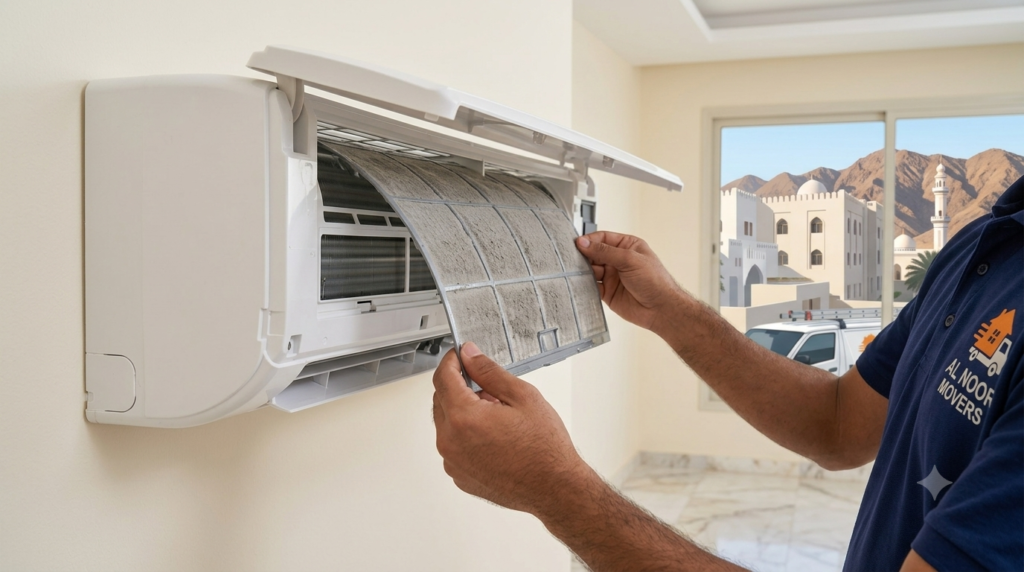
Of all the things you can do to keep your air conditioning running efficiently in Oman’s intense climate, cleaning your AC filter regularly is the single most impactful — and the one most commonly neglected. It costs nothing. It takes less than fifteen minutes. It requires no tools, no technical knowledge, and no professional training. And yet a blocked AC filter is the most common cause of poor cooling, high electricity bills, and premature AC breakdown reported by homeowners across Muscat, Sohar, Nizwa, and Ibra every summer.
In Oman’s dusty environment — where AC units run almost continuously for eight to ten months of the year — filters become blocked significantly faster than in cleaner, cooler climates. A filter that might need cleaning every two months in a European home needs attention every three to four weeks in Muscat. During peak summer — June to August — when AC runs non-stop and dust levels are at their highest, some Muscat households find their filters visibly blocked within two to three weeks of the last cleaning.
A blocked filter does not just reduce cooling performance. It forces the compressor to work harder, increasing electricity consumption by up to twenty-five percent. It causes the evaporator coil to run colder than designed, eventually freezing over completely. And it restricts the airflow that the AC system needs to move heat efficiently — ultimately causing the kind of overheating stress that leads to compressor failure years before the unit’s natural end of life.
This step-by-step guide teaches you exactly how to clean your AC filter at home in Oman — safely, correctly, and thoroughly — so your AC unit performs at its best throughout Oman’s demanding climate conditions.
WHY AC FILTER CLEANING MATTERS MORE IN OMAN THAN MOST COUNTRIES
Before walking through the cleaning steps, understanding specifically why filter cleaning is so critical in Oman helps motivate the habit of doing it regularly rather than letting it slip.
Oman’s Dust Load Is Exceptionally High
The Omani environment delivers a constant supply of fine dust, sand particles, and airborne debris to every AC filter in the country. Muscat’s periodic shamal winds carry fine Saharan dust across the city. Sohar’s industrial port area generates additional particulate matter from shipping and industrial activity. Nizwa and Ibra’s proximity to the desert means dust accumulation rates are even higher than in coastal Muscat.
A filter that was perfectly clean this week can be visibly grey and partially blocked within two to three weeks in a Muscat home during summer. In Nizwa or Ibra during a period of strong desert winds, the same filter might need attention after ten to fourteen days.
Continuous Operation Means Continuous Filtration
In most countries, AC runs seasonally — typically four to six months per year. In Oman, residential AC runs for eight to ten months and often twenty-four hours a day during summer. This means the filter is actively capturing dust continuously rather than intermittently. The cumulative dust load on an Omani AC filter in a single year of operation is equivalent to multiple years of filter use in a seasonal climate.
Blocked Filters in Oman’s Heat Create a Dangerous Cycle
A blocked filter in Oman’s summer heat triggers a cascade of problems that worsens faster than in milder climates. Reduced airflow causes the evaporator coil to get too cold — eventually freezing over. When the coil freezes, airflow stops completely. The compressor continues trying to pump refrigerant through a blocked system. Compressor temperature rises. In Oman’s ambient heat — where outdoor temperatures are already extreme — a compressor overheating from filter-caused airflow restriction reaches failure temperature faster than in a temperate climate.
The result of a neglected filter in Muscat is not just reduced cooling — it is an accelerated path to the most expensive AC repair there is. Cleaning your AC filter at home in Oman every three to four weeks prevents this entire cascade.
BEFORE YOU START — UNDERSTANDING YOUR AC FILTER
Different AC units have different filter configurations. Before cleaning your AC filter at home in Oman, confirm what type of filter your unit has and where it is located.
Standard Mesh Filter — The Most Common Type in Oman
The vast majority of split AC units in Muscat homes and across Oman use a standard mesh filter — a thin panel of plastic or fibreglass mesh stretched across a light plastic frame. These filters are designed to be removed, washed, dried, and replaced repeatedly throughout the unit’s lifespan. They are the simplest type to clean and are what this guide primarily addresses.
Mesh filters are located inside the indoor unit behind the front panel — the plastic casing that houses the indoor evaporator fan and coil. On most Muscat-area split units, the front panel lifts upward on hinges or clips upward and forward to reveal the filter beneath.
Electrostatic Filters — Some Premium Units
Some higher-end AC units — particularly premium Daikin, Mitsubishi Electric, and some Panasonic models common in Qurum and Madinat Sultan Qaboos villas — use electrostatic filters that carry a static charge to attract dust particles. These require the same cleaning approach as standard mesh filters but should be handled more gently as the electrostatic medium can be damaged by harsh scrubbing.
Carbon or Activated Charcoal Filters — Supplementary Layer
Some AC units have an additional layer of carbon or activated charcoal filter positioned behind the main mesh filter. These supplementary filters help remove odours and fine particles. They are typically not washable — they require replacement when exhausted rather than cleaning. Check your unit’s manual to confirm whether your AC has a carbon filter and what its replacement schedule is.
High-Efficiency Filters — Specialty Units
Some ducted AC systems and commercial units in Oman use high-efficiency pleated filters — similar to HVAC filters used in commercial buildings. These are typically not washable and require replacement rather than cleaning. This guide covers standard residential mesh filter cleaning applicable to the vast majority of split AC units in Oman’s residential market.
WHAT YOU NEED TO CLEAN YOUR AC FILTER AT HOME IN OMAN
The tools and materials for cleaning your AC filter at home in Oman are simple and likely already in your home.
Required:
- Soft brush or old soft toothbrush
- Mild liquid dish soap or detergent
- A bucket or your bathroom sink or shower
- Running water — cold or lukewarm
- A clean dry towel or cloth
- A space in the shade for the filter to air dry
Optional but useful:
- A small handheld vacuum cleaner with a soft brush attachment — for the initial dust removal step
- A soft sponge — for gently washing without scrubbing
- A torch or phone light — for inspecting the filter and the area behind it
What you should never use:
- Hot water — can warp the plastic frame of the filter
- Stiff wire brushes or abrasive scrubbers — will damage the mesh
- Strong chemical cleaners, bleach, or solvent-based cleaners — will damage the filter material and may leave residues that affect air quality
- A high-pressure jet washer or strong hose setting — the force can push dust through the mesh rather than removing it and can damage the filter frame
STEP-BY-STEP GUIDE — HOW TO CLEAN YOUR AC FILTER AT HOME IN OMAN
Follow these steps in order for a thorough, safe AC filter cleaning.
Step 1 — Switch the AC Unit Off Completely
Before touching any part of your AC unit, switch it off at the remote control and then at the wall switch or circuit breaker for the unit. Do not attempt to open the front panel or remove the filter while the unit is running.
In Oman, where AC runs continuously during summer, residents sometimes attempt to change or clean filters with the unit running — this is both unsafe and counterproductive. The running fan will pull dust back into the unit as you remove the filter and will prevent you from cleaning the filter housing area safely.
Switch off, wait two minutes for the fan to stop completely, and then proceed.
Step 2 — Open the Front Panel of the Indoor Unit
The front panel of your split AC indoor unit opens to reveal the filter. The method varies slightly between brands and models — here are the most common approaches found on AC units in Muscat homes.
Lift-up panel: The most common type in Oman. Grasp the front panel on both sides near the bottom and lift upward — the panel will hinge open on clips at the top, revealing the filter beneath. Do not force it — if it does not open easily, check for release clips on the sides before applying more pressure.
Pull-forward and lift: Some units — common on older Carrier and Gree models in Muscat — require the panel to be pulled gently outward at the bottom and then swung upward on top hinges.
Side clip release: Some units have small clip buttons on each side of the front panel that must be pressed simultaneously before the panel will open. Check both sides of the panel if the standard lift approach does not work.
If you are unsure how to open your specific unit’s panel, the user manual for your AC brand and model will show the exact method. Most manuals are available as PDF downloads from the manufacturer’s website if the original is not available.
Step 3 — Remove the Filter Carefully
With the front panel open, the filter is typically visible as one or two thin panels of mesh material sitting in channels or clips inside the unit. Slide the filter straight out of its channel or unhook it from its clip mounting — do not bend or force it.
Some Muscat-area split units have two filters — one on each side of the indoor unit. Remove both if your unit has this configuration and clean them together.
Hold the filter over a rubbish bag or bucket as you remove it — a heavily blocked Oman filter can drop significant quantities of dust as it is removed and tipped, and you do not want this dust falling into your room or back into the open AC unit.
Step 4 — Initial Dry Dust Removal
Before washing the filter, remove as much loose dust as possible while the filter is still dry. There are two effective methods for this step.
Method A — Gentle tapping:
Take the filter outside or over a rubbish bag. Hold it firmly by the frame and tap it gently but firmly against the palm of your other hand — or against a hard surface like the edge of a bin — on the dusty side. This dislodges and releases the accumulated dust in large amounts. You will likely be surprised by how much dust falls off.
Repeat the tapping from different angles until no more significant dust falls from tapping.
Method B — Soft vacuum brush:
If you have a handheld vacuum cleaner with a soft brush attachment, run it gently over the dusty side of the filter — the side that faces into the room — with the vacuum on a low to medium setting. Do not press hard — just let the brush and suction do the work. This is the cleanest and most thorough method for the initial dry removal step.
Why this step matters: Washing a heavily dust-loaded filter under water can cause the dust to clump and push deeper into the mesh rather than washing away cleanly. The dry removal step prevents this — the wash step then removes the fine residual dust that dry removal cannot dislodge.
Step 5 — Wash the Filter Under Running Water
Take the filter to your bathroom sink, shower, or garden area. Run cold or lukewarm water — never hot — over the filter.
The correct water direction:
Water should flow through the filter from the clean side to the dusty side — that is, enter the filter from the inside face (the side that faces the evaporator coil) and exit from the outside face (the side that faces the room and accumulated the dust). This water direction pushes dust out in the same direction it entered — preventing it from being pushed further into the mesh.
Practical way to achieve this: Hold the filter with the room-facing dusty side pointing downward under the running water. The water flows through the mesh from inside to outside, carrying dust out the dusty face and down the drain. This is the opposite of the intuitive direction — most people instinctively wash from the dusty face inward, which is the wrong direction.
Washing technique: Allow the running water to do the primary work — do not scrub the mesh aggressively as this can stretch or damage the filter material. If dust residue is stubborn, apply a very small amount of mild liquid dish soap to a soft sponge or soft toothbrush and gently work it across the mesh surface using light, circular motions. Rinse thoroughly after any soap application — soap residue left in the filter will affect airflow and can produce a slightly chemical smell when the unit runs.
Step 6 — Inspect the Filter After Washing
Hold the clean, wet filter up against a light source — a window, a torch, or your phone light. Look through the mesh from one side — you should be able to see light clearly through every part of the mesh. Any area where light does not pass through clearly indicates remaining blockage.
If blocked areas remain after washing, repeat the wash step — focusing water on the blocked areas — until the filter is uniformly clear throughout.
Also inspect the filter frame during this step. Check for any cracks in the plastic frame, any distortion from previous improper handling or heat exposure, and any damage to the mesh that would reduce its effectiveness. A damaged filter should be replaced rather than returned to service.
Step 7 — Dry the Filter Completely Before Reinstalling
This step is the one most commonly skipped — and skipping it causes problems. A wet filter returned to service inside an AC unit introduces moisture into the evaporator coil housing, potentially promoting mould growth and increasing the moisture load on the AC system.
The correct drying approach:
Shake the filter gently after washing to remove excess water. Stand it in a shaded, ventilated area — never in direct Oman sun, which can warp the plastic frame. Allow it to dry completely in the shade. Depending on the ambient humidity and shade temperature, drying time in Muscat is typically thirty to sixty minutes.
To check if the filter is dry, press a dry cloth gently against the mesh — if any moisture transfers to the cloth, the filter needs more drying time.
In an emergency situation where the filter must be returned quickly: Pat both sides of the filter with a clean dry towel to remove surface moisture, then wave the filter through the air for a few minutes to accelerate evaporation. While not as thorough as full shade drying, this reduces the moisture being returned to the unit compared to reinstalling a dripping-wet filter.
Never use a hairdryer or heat gun to dry the filter. The heat will warp the plastic frame and damage the mesh material.
Step 8 — Clean the Filter Housing Area Inside the Unit
With the filter removed and drying, take a moment to clean the filter housing area inside the open AC unit — the area just inside the front panel where the filter sits.
Using a soft dry cloth or a soft brush attachment on a handheld vacuum, gently remove any dust that has accumulated in the filter channel tracks, on the visible parts of the evaporator coil fins just behind the filter position, and on the inside surface of the front panel itself.
Important precautions for this step:
Do not insert anything into the evaporator coil fins — they are delicate aluminium fins that bend permanently if touched firmly. Use only the soft brush or cloth on the visible dust around the coil edges. Do not spray water or cleaning solution into the open unit — water in the wrong location can damage electrical components.
If you can see a significant accumulation of dust on the evaporator coil surface — the silver or copper fins visible behind the filter position — this indicates the filter has not been cleaned frequently enough and dust has bypassed the filter and accumulated on the coil itself. Coil cleaning requires professional attention — this is not something to attempt at home. If you see a dirty coil, note it for your next professional AC service booking.
Step 9 — Reinstall the Clean, Dry Filter
With the filter completely dry and the housing area cleaned, slide the filter back into its channel or clips inside the unit. The filter should slide in smoothly and sit flush in its housing with no gaps around the edges — gaps around the filter allow unfiltered air to bypass the mesh and accumulate dust directly on the evaporator coil.
Confirm the filter is fully seated before closing the front panel. Close the front panel by reversing the opening procedure — lower it back to the closed position until it clicks firmly into place on both sides. Press gently along the bottom edge of the panel to confirm both side clips are engaged.
Step 10 — Switch the Unit Back On and Test
Switch the AC unit back on at the wall switch and then at the remote. Set it to your normal cooling temperature and fan speed. Within five minutes of the unit running with a clean filter, you should notice an immediate improvement in airflow from the indoor unit — the airflow volume will be noticeably stronger than before cleaning, and the unit will reach your set temperature faster.
Listen for any unusual sounds during the first five minutes of operation after filter reinstallation — any rattling that was not present before may indicate the filter is not fully seated in its housing and needs to be repositioned.
HOW OFTEN TO CLEAN YOUR AC FILTER IN OMAN
The question of how often to clean your AC filter at home in Oman is one of the most commonly asked — and the answer varies by location, season, and usage pattern.
General Frequency Guidance for Oman
Peak summer — June to August in Muscat:
Clean every two to three weeks. AC runs continuously twenty-four hours a day during this period and Muscat’s summer dust levels are at their highest. Filters can become noticeably blocked within three weeks during peak summer, particularly in properties near main roads, construction activity, or in areas exposed to shamal wind events.
Shoulder season — April to May and September to October:
Clean every three to four weeks. Temperatures are high and AC usage is still heavy. Dust levels are moderate.
Cooler months — November to March:
Clean every four to six weeks. AC usage is lighter in many Muscat homes during the cooler months and dust levels are generally lower. Some households switch AC off during the coolest nights of December and January — reducing filter loading during this period.
Location-Specific Frequency Adjustments
Coastal Muscat — Al Mouj, Qurum beach, Muttrah waterfront:
In coastal areas, humidity combines with dust to create a sticky filter blockage that forms faster than in drier inland areas. Clean every two to three weeks throughout the year, not just in summer.
Sohar Industrial Area:
Properties near Sohar’s industrial port face higher particulate loading than residential Muscat. Clean filters every two weeks during the main AC season — the industrial particulate contamination is finer and stickier than standard domestic dust.
Nizwa and Ibra:
Desert dust exposure in these inland cities is higher than coastal Muscat. Clean every two to three weeks during the hot season and check filters every four weeks in the cooler months.
New construction areas in Muscat:
Properties near active construction sites — common in developing areas of Al Maabilah, Al Hail, and Amerat in Al Seeb — face extremely high dust loads from construction activity. Clean filters every two weeks regardless of season when living near active construction.
The Simple Visual Test
The most reliable frequency guide for cleaning your AC filter at home in Oman is the simple visual test — pull the filter out once a week and hold it up to a light. When you can see light clearly through the entire mesh, the filter is acceptably clean. When areas of the mesh are grey, blocked, or opaque, the filter needs cleaning regardless of how recently it was last done.
Setting a weekly thirty-second filter check as a habit takes almost no time and ensures you catch a fast-blocking filter before it significantly impacts performance.
SIGNS YOUR AC FILTER NEEDS CLEANING RIGHT NOW
These signs indicate your AC filter in your Muscat home needs cleaning immediately — without waiting for your next scheduled cleaning date.
Visibly reduced airflow from the indoor unit. If you can feel that the air coming from the indoor unit is less forceful than usual, the filter is likely blocked and restricting airflow.
AC is running but the room is not getting cold. A blocked filter is one of the most common causes of poor cooling in Muscat homes — and the first thing to check when your AC is running but not cooling effectively.
AC is running almost continuously without cycling off. A blocked filter means the AC works harder and longer to reach the set temperature — the compressor runs without stopping because the cooling target is never reached.
Ice or frost visible on the indoor unit or copper pipe. A blocked filter restricts warm room air reaching the evaporator coil — the coil gets colder than normal and ice forms on it. This is an urgent sign requiring immediate filter cleaning followed by a defrost period before restarting.
Noticeably higher electricity bills without changed usage patterns. A blocked filter forces the compressor to draw significantly more power. An unexplained increase in your Muscat electricity bill is worth investigating with a filter check.
Musty or stale smell from the AC unit. While not always filter-related, a musty odour from the AC can indicate dust and moisture accumulation on a neglected filter or on the evaporator coil behind it.
Visible dust on the filter through the closed front panel. Some AC units have slightly open panel designs where the filter is partially visible with the panel closed. If you can see obvious dust accumulation through these gaps, the filter needs attention.
WHAT TO DO IF YOUR AC FILTER IS DAMAGED OR WORN OUT
Regular inspection of your AC filter as part of the cleaning process reveals when a filter has reached the end of its useful life and needs replacement rather than another cleaning cycle.
Signs a Filter Needs Replacing
Tears or holes in the mesh: Any tear or hole in the filter mesh allows unfiltered air — and the dust it carries — to reach the evaporator coil directly. A torn filter should be replaced immediately.
Warped or cracked plastic frame: A warped frame means the filter cannot sit correctly in its housing, creating gaps around the edges that bypass the filter mesh. Replace the frame and filter together.
Permanent discolouration that does not wash out: Some industrial or cooking contamination — grease in kitchen areas, tar from cigarette smoke — embeds in filter mesh and cannot be removed by washing. A filter that remains grey or discoloured after thorough washing is not functioning at full capacity and should be replaced.
Distorted or compressed mesh: A filter that has been scrubbed too hard or exposed to too much heat may have a distorted or compressed mesh that restricts airflow even when clean. Replace it.
How to Get a Replacement Filter in Muscat
Most AC brands with significant Muscat market presence have local spare parts availability through their authorised service agents or through general AC parts suppliers in Muscat’s hardware and electrical supply areas — particularly in Ruwi, Wadi Kabir, and Seeb Industrial Area.
When ordering a replacement filter, have the following information ready: your AC unit’s brand, the exact model number (found on the data plate on the outdoor condenser unit and often also on the indoor unit), and the unit’s capacity in BTU or tonnes. This information ensures the correct replacement filter is supplied — generic filters that do not exactly match your unit’s dimensions will have gaps around the edges that reduce effectiveness.
Al Noor Movers can source replacement filters for all major AC brands during a professional service visit — if your filter needs replacement beyond simple cleaning, let our technician know during their visit and we can supply and fit the correct replacement.
WHAT FILTER CLEANING CANNOT FIX — WHEN TO CALL A PROFESSIONAL
Understanding the limits of what cleaning your AC filter at home in Oman can achieve helps you know when professional AC service is needed alongside your regular filter maintenance.
Dirty Evaporator Coil
If you look inside your open AC unit with the filter removed and the evaporator coil — the silver fins visible just behind the filter position — appears grey or covered in dust, this coil contamination is not removable by home filter cleaning. The coil itself needs professional cleaning using specialist coil cleaner and appropriate equipment.
A dirty evaporator coil in a Muscat home significantly reduces cooling performance regardless of how clean the filter is — because the dirty coil cannot absorb heat from the room air efficiently. Professional coil cleaning is typically included in an annual AC service visit and restores a significant proportion of the unit’s original cooling capacity.
Low Refrigerant
If your AC is not cooling properly and a clean filter does not resolve the issue, the next most common cause is low refrigerant from a leak. This requires a certified AC technician in Muscat — refrigerant pressure testing, leak detection, leak repair, and precise recharge are all professional tasks requiring specialist equipment.
Blocked Drain Pipe
If water is dripping or pooling from your indoor AC unit even after cleaning the filter and running the unit, the drain pipe is likely blocked. While filter cleaning prevents most drain pipe blockages from developing — a clean filter means less dust reaching the drain pan — an established blockage requires the drain to be cleared physically, either by the homeowner with a drain snake or by a technician.
Electrical or Mechanical Faults
Any AC problem that persists after filter cleaning and a brief defrost period if ice was present — poor cooling, unusual noises, electrical tripping, error codes on the display — requires professional diagnosis. Clean filters cannot resolve mechanical or electrical faults.
BUILDING A FILTER CLEANING HABIT — MAKING IT EASY IN OMAN
The challenge with AC filter cleaning is not the task itself — it is remembering to do it consistently in the busy routine of daily life in Muscat. Here are practical approaches to making filter cleaning a reliable habit.
Set a Smartphone Reminder
Set a recurring reminder on your phone every three weeks — labelled CLEAN AC FILTERS — that repeats automatically throughout the AC season. This removes the mental load of remembering when the filters were last cleaned and ensures the task happens on schedule rather than whenever you notice the cooling performance declining.
Clean All Filters in One Session
If your Muscat villa has multiple AC units — four bedrooms, two living areas, a majlis — cleaning all filters in a single session rather than approaching them individually is significantly more efficient. Allow one hour for a full multi-unit filter cleaning session in a large villa, working through the rooms systematically with your materials set up in one location.
Coordinate with Other Household Maintenance
Link filter cleaning to another regular household task — when you change the water filter, when you clean the bathroom, when you do your monthly grocery planning. This pairing anchors the filter cleaning habit to an existing routine rather than requiring it to stand alone.
Keep Your Packing Materials Accessible
Keep your filter cleaning materials — a soft brush, a cloth, and a designated bucket for filter washing — accessible rather than stored away. When the materials are readily available, the task is completed quickly. When materials need to be located first, the task gets deferred.
THE FINANCIAL CASE FOR REGULAR FILTER CLEANING IN OMAN
For any Muscat homeowner or tenant unconvinced by the performance arguments, the financial case for regular AC filter cleaning at home in Oman is straightforward and compelling.
Electricity savings: A blocked AC filter increases electricity consumption by fifteen to twenty-five percent as the compressor works harder to maintain cooling against restricted airflow. For an average Muscat villa with six AC units running through a full summer, this additional electricity consumption can add OMR 20 to OMR 50 to the monthly electricity bill. Over a full AC season of eight months, regular filter cleaning saves OMR 160 to OMR 400 compared to running on blocked filters.
Reduced professional service frequency: An AC unit with regularly cleaned filters accumulates dust on the evaporator coil significantly more slowly than one with neglected filters. Professional coil cleaning — typically OMR 20 to OMR 40 per unit — is needed less frequently when filters are maintained properly.
Extended compressor lifespan: The compressor in a split AC unit in Muscat costs OMR 150 to OMR 400 to replace. The leading cause of premature compressor failure in Oman is sustained operation under restricted airflow from blocked filters — the thermal stress of working hard against a blocked filter in Muscat’s ambient heat accelerates compressor wear significantly. Regular filter cleaning directly extends compressor lifespan — the compressor replacement you avoid by maintaining clean filters is worth far more than the fifteen minutes per filter cleaning session.
Avoided emergency repair costs: An AC unit that fails completely in July in Muscat — because a neglected filter caused coil icing, compressor overheating, and component failure — requires emergency repair in the busiest and most expensive period for AC technicians across the city. Emergency AC repair call-out premiums, combined with the repair cost itself, dwarf the total time investment of a year of regular filter cleaning at home.
The arithmetic is unambiguous. Regular filter cleaning at home in Oman is the highest-return maintenance activity available to any Muscat homeowner or tenant — saving far more money than it costs in time.
BEYOND THE FILTER — WHAT ELSE TO CHECK WHILE YOU ARE THERE
While you have the AC unit open for filter cleaning, spend an additional two minutes on these quick checks that are only possible with the front panel open.
Check the evaporator coil for ice. If you see ice or frost on the coil fins, the filter was blocking sufficiently to cause coil icing. Run the unit on fan-only mode for thirty to sixty minutes after replacing the clean filter to defrost the coil before switching back to cooling mode.
Check the drain pan for standing water. The drain pan sits below the evaporator coil and collects the condensate water that drips off during cooling operation. A drain pan with standing water indicates a blocked drain pipe — contact a professional AC technician in Muscat to clear the blockage before it overflows and causes water damage.
Listen for unusual sounds in the first five minutes after restart. A rattling that was not there before may indicate the filter is not fully seated. A hissing sound may indicate a refrigerant issue. A grinding or scraping sound requires immediate switch-off and a call to an AC technician in Muscat.
Check the front panel condition. While open, check that the front panel hinges and clips are in good condition — a panel that does not close firmly creates gaps that allow unfiltered air to bypass the filter at the panel edges.
AC FILTER CLEANING VS PROFESSIONAL AC SERVICE — UNDERSTANDING THE DIFFERENCE
A common question from Muscat homeowners is whether regular filter cleaning at home replaces the need for professional AC servicing. The answer is clearly no — but understanding why helps clarify what each activity achieves.
What Home Filter Cleaning Achieves
Regular filter cleaning at home in Oman keeps the filter itself clear — maintaining the airflow through the indoor unit that the entire AC system depends on. It prevents the most common single cause of AC performance decline in Muscat. It is a maintenance task that any homeowner can and should do regularly without professional involvement.
What Professional AC Service Achieves
A professional AC service in Muscat — carried out annually by a certified technician — addresses everything beyond the filter that requires technical access, specialist equipment, or professional knowledge.
Professional service includes deep cleaning of the evaporator coil that filter cleaning cannot reach — removing accumulated dust from the fins and surface of the coil itself. It includes cleaning the condenser coil on the outdoor unit — the heat-releasing surface that has no filter protection and accumulates Oman’s outdoor dust directly. It includes checking refrigerant pressures to identify developing leaks before they cause compressor damage. It includes checking electrical connections, testing capacitors, inspecting fan motors, and verifying drainage — none of which are visible or accessible during home filter cleaning.
The correct approach for Muscat homeowners is to do both — clean your own filter every three to four weeks throughout the AC season, and book a professional annual AC service in Muscat once a year, ideally in March or April before the summer peak arrives.
Al Noor Movers provides professional AC servicing across all Muscat areas and across Oman — with annual maintenance contracts available that ensure your professional service happens on schedule without you needing to remember to book it. Our maintenance contracts also include priority emergency call-out response for the year, at a fixed annual price that covers all scheduled service visits.
CONCLUSION
Cleaning your AC filter at home in Oman is the single most impactful maintenance action you can take to keep your air conditioning running efficiently through Muscat’s demanding climate. It is free, it takes fifteen minutes, and it directly affects your cooling performance, electricity bills, and the long-term health of your AC compressor.
The ten steps in this guide — switching off, opening the panel, removing the filter, dry dust removal, washing in the correct water direction, inspecting, drying completely, cleaning the housing area, reinstalling the dry filter, and testing — cover every aspect of the correct filter cleaning process for residential AC units in Oman.
Do it every three to four weeks during the AC season. Do it every two weeks in peak summer or in high-dust locations. Do it whenever you notice reduced airflow or cooling performance decline. And do it alongside — not instead of — the annual professional AC service that addresses everything beyond the filter.
If you need professional AC service, emergency AC repair, or annual maintenance contracts for your Muscat home or business — Al Noor Movers is ready. Certified technicians, same-day response, all brands covered across Muscat and Oman.
Need Professional AC Service in Muscat After Cleaning Your Filter?
Al Noor Movers provides professional AC repair and maintenance across Muscat and Oman. Certified technicians, annual contracts available, same-day emergency response.
Visit us at: www.alnoormovers.com | Call: +968 9294 2088 Book Professional AC Service