
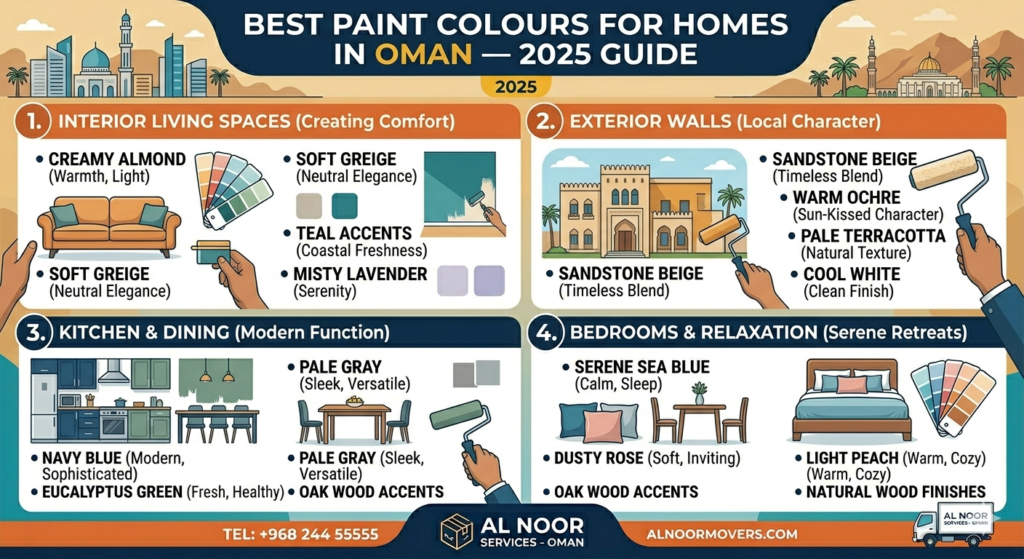
Choosing the right paint colour for your home in Oman is one of the most impactful decisions you will make during any renovation or house painting project — and one of the most underestimated. Get it right and your rooms feel cooler, larger, and more welcoming. Get it wrong and even a perfectly executed paint job can leave a space feeling uncomfortable, dark, or mismatched with Oman’s unique light and climate.
Oman’s environment presents specific challenges and opportunities that make colour selection genuinely different here than in Europe, Southeast Asia, or North America. The intensity of natural light in Muscat, the heat reflected from external walls, the dust-laden air during certain seasons, and the architectural character of Omani villas and apartments all influence which colours work beautifully and which disappoint once painted on a full wall.
This 2025 guide covers the best paint colours for homes in Oman — for interiors, exteriors, specific rooms, and different property types — with practical advice on finishes, brands, and how to test colours before committing to a full room. Whether you are repainting a villa in Madinat Sultan Qaboos, refreshing an apartment in Al Khuwair, or choosing colours for a new property in Sohar or Nizwa, this guide gives you everything you need to choose with confidence.
WHY COLOUR SELECTION IS DIFFERENT IN OMAN
Before looking at specific colours, it is worth understanding what makes colour choice in Oman unique — because the advice that works in a European or South Asian context does not always translate to a Muscat home.
The Light Is Intense and Warm
Natural light in Oman — particularly in Muscat — is significantly more intense and warmer in tone than in northern climates. This means colours that look soft and subtle on a paint swatch or on a European interior design website often appear much brighter, more saturated, or more yellow in an Omani room with direct sunlight.
Cool whites that look crisp in London look stark and slightly blue in Muscat. Warm whites that look creamy in a north-facing London flat look rich and golden in a south-facing Muscat villa. Always test colours in your actual space before committing.
Interior Spaces Are Often Large
Omani villas typically have large open-plan living areas, high ceilings, and generous room sizes. Large spaces handle deeper, richer colours far better than smaller rooms. A colour that feels overwhelming in a compact apartment bedroom can look stunning in a spacious Muscat villa sitting room.
Dust and Heat Affect Exterior Colour Choice
For exterior painting in Oman, the combination of intense UV radiation, high temperatures, and dust means colour choice directly affects both the longevity of the paint and the heat absorbed by the building. Darker exterior colours absorb significantly more heat — relevant both for comfort inside and for paint longevity. Lighter colours reflect heat and stay cooler.
Oman’s Architecture Has Its Own Aesthetic
Traditional Omani architecture uses natural stone, rendered white walls, wooden screens, and earthy terracotta tones. Contemporary Muscat properties blend this heritage with modern finishes — marble floors, high ceilings, large windows, and clean lines. The best paint colours for homes in Oman complement this architectural character rather than fighting against it.
BEST INTERIOR PAINT COLOURS FOR OMAN HOMES IN 2025
1. Warm White — The Foundation of Every Omani Home
Best for: Living rooms, hallways, open-plan spaces, ceilings
Warm white is the single most consistently successful interior paint colour for homes in Oman. Not stark brilliant white — which reads as cold and clinical under Oman’s intense natural light — but a white with warm undertones of cream, sand, or the faintest hint of stone.
In Oman’s light, warm whites create exactly the feeling most homeowners want — bright, airy, spacious, and clean — without the harshness of a pure white or the chilliness of a cool-toned white.
Recommended shades:
- Jotun Pale Wheat — a beautifully balanced warm white with sandy undertones, works perfectly in large Muscat living areas
- Dulux White Cotton — softer than brilliant white, warm without being obviously cream
- Jotun Whisper White — a very slightly warmer shade that handles strong sunlight elegantly
Finish recommendation: Matt or soft sheen for walls, semi-gloss for woodwork and doors
Pro tip: Test warm white on a large piece of card — at least A3 size — and stick it on your wall for two full days. Look at it at different times of day including morning light, midday, and evening artificial light. The same white can look dramatically different at 7am and 7pm in a Muscat room.
2. Desert Sand and Warm Beige — Oman’s Natural Palette
Best for: Living rooms, master bedrooms, dining rooms, entrance halls
Sand, beige, and warm stone tones are among the best paint colours for homes in Oman for one simple reason — they are the colours of Oman itself. These tones connect a home’s interior to the natural landscape outside, feel instinctively harmonious in this environment, and work beautifully with the marble floors, wooden furniture, and natural fabric textures common in Muscat homes.
In 2025 the most sophisticated interpretation of this palette moves beyond plain magnolia into richer, more complex sand and stone tones — colours with depth and warmth that shift subtly as light changes through the day.
Recommended shades:
- Jotun Sandstorm — a complex warm sand with just enough depth to look intentional rather than default
- Dulux Perfectly Taupe — a warm mid-tone that bridges sand and grey beautifully
- Berger Sahara Dust — an Oman-specific recommendation that handles the local light very well
- Jotun Desert Rose — for bedrooms, a warm blush-sand tone that feels both contemporary and deeply suited to the Omani environment
Finish recommendation: Matt for walls to reduce glare in bright rooms, eggshell for higher-traffic areas
Pairs well with: Crisp white ceilings, dark wood furniture, brass or gold fixtures, terracotta accessories
3. Soft Sage and Muted Greens — The 2025 Trend That Works in Oman
Best for: Kitchens, dining rooms, home offices, feature walls
Soft sage green has been one of the dominant interior colour trends globally for the past two years and it translates exceptionally well to Omani homes. Unlike brighter greens that can clash with Oman’s warm light, sage and muted olive tones sit in a beautiful middle ground — warm enough to feel natural in strong sunlight, cool enough to feel fresh and calming in a hot climate.
In a Muscat kitchen sage green cabinetry or a sage feature wall feels both contemporary and connected to the natural world outside. In a home office it is calm and focused without feeling cold.
Recommended shades:
- Jotun Sage Advice — exactly what the name suggests, a perfectly balanced sage
- Dulux Mellow Sage — slightly warmer than classic sage, excellent in rooms with strong afternoon light
- Jotun Olive Branch — deeper and more complex, excellent for a feature wall or kitchen
- Nippon Paint Forest Whisper — a soft muted green that works beautifully in Oman’s light
Finish recommendation: Eggshell or soft sheen for kitchens, matt for feature walls and living spaces
Pairs well with: Warm wood tones, white or cream walls on adjacent surfaces, natural rattan or linen textures, brass fixtures
4. Terracotta and Warm Clay — Deeply Omani and Beautifully Contemporary
Best for: Feature walls, dining rooms, home offices, media rooms
Terracotta has undergone a complete reinvention in interior design and in 2025 it is one of the most sophisticated and contextually appropriate colour choices for homes in Oman. Traditional Omani architecture uses terracotta and clay in everything from building materials to decorative craft — so a terracotta wall in a contemporary Muscat home feels both modern and deeply rooted in place.
The key is choosing the right shade. The best paint colours for homes in oman this family are muted, dusty terracottas — not the saturated orange-red of the 1990s but complex clay tones with brown and grey mixed in that feel earthy, warm, and refined.
Recommended shades:
- Jotun Terracotta Dream — a muted, sophisticated clay tone perfect for feature walls
- Dulux Moroccan Spice — warmer and slightly deeper, excellent in large rooms with high ceilings
- Jotun Adobe — an earthy warm clay that bridges terracotta and sand beautifully
- Berger Fired Earth — a deep complex terracotta that works brilliantly in dining rooms and studies
Finish recommendation: Matt only — terracotta in any sheen finish reads too orange. Matt gives it depth and elegance.
Pairs well with: Warm white ceilings and adjacent walls, natural linen and cotton soft furnishings, dark wood or black metal furniture, Omani craft objects and ceramics
Important: Terracotta works best as a feature wall or in rooms with controlled artificial lighting. A full room in deep terracotta requires confidence and works better in larger Muscat villa spaces than in smaller apartments.
5. Soft Blue-Grey — Cooling and Contemporary
Best for: Bedrooms, bathrooms, home offices
One of the most psychologically appropriate colour choices for homes in Oman is also one of the most underused — soft blue-grey. In a climate where heat is constant and intense, a bedroom or bathroom painted in a cool blue-grey tone creates a genuine sense of visual coolness and calm that warmer colours simply cannot provide.
The key word is soft. Deep navy or bright blue reads as jarring in Oman’s strong light. But soft, dusty blue-greys — colours that sit between blue, grey, and sometimes a hint of green — feel sophisticated, restful, and genuinely cooling.
Recommended shades:
- Jotun Blue Whisper — a beautifully soft blue-grey that handles Oman’s light with elegance
- Dulux Coastal Grey — a complex blue-grey-green that feels like sea glass
- Jotun Morning Mist — a very light blue-grey that reads almost as a cool white in bright rooms
- Nippon Paint Sky Veil — a soft chalky blue perfect for master bedrooms in Muscat villas
Finish recommendation: Matt for bedrooms, eggshell for bathrooms
Pairs well with: Crisp white trim and ceilings, light wood furniture, white or cream bedlinen, silver or brushed nickel fixtures
6. Deep Charcoal and Moody Tones — For the Confident Decorator
Best for: Feature walls, media rooms, master bedrooms, home offices
The idea of using deep, dark colours in Oman’s hot and bright environment sounds counterintuitive — and most homeowners here default to light and neutral. But in the right space, a deep charcoal, slate, or even near-black wall creates a dramatic, cocooning atmosphere that is deeply sophisticated and increasingly popular in Muscat’s more design-forward homes.
The key is context. Dark walls work in rooms with controlled lighting — a media room, a master bedroom where shutters control light, or a dedicated home office. They do not work well in rooms with large uncontrolled windows where strong Oman sunlight will fight constantly with the dark wall.
Recommended shades:
- Jotun Charcoal Depth — a rich complex charcoal with warm undertones
- Dulux Overtly Olive — a very deep olive-black that feels both dramatic and natural
- Jotun Midnight Hour — near black with blue undertones, stunning in a media or cinema room
- Berger Graphite Stone — a versatile dark grey that works in both modern and traditional Omani interiors
Finish recommendation: Matt only for dark colours — any sheen on a dark wall in a bright room creates unwanted reflections
Pairs well with: Warm brass or gold fixtures and lighting, light-coloured furniture as contrast, white or cream adjacent walls, carefully positioned directional lighting
BEST EXTERIOR PAINT COLOURS FOR OMANI VILLAS AND HOMES
Exterior colour choice in Oman involves different priorities to interior selection. Heat reflection, UV resistance, dust visibility, and architectural context all play an important role alongside pure aesthetics.
The Heat Reflection Principle
In Oman’s climate, lighter exterior colours are almost always the better practical choice. Light colours reflect solar radiation rather than absorbing it — keeping walls cooler, reducing heat transfer into the building, extending the life of the paint film, and lowering the internal temperature of the property.
Dark exterior colours absorb heat, increase internal temperatures, and cause paint to crack and fade significantly faster under Oman’s intense UV. For exterior painting in Oman, every shade you go darker adds measurably more heat absorption.
7. Classic White and Off-White — Timeless and Practical
Best for: Villa exteriors, compound walls, rendered facades
White and off-white exteriors are traditional in Omani architecture for excellent reasons — they reflect maximum heat, they look clean and well-maintained, they complement the natural landscape, and they stand out beautifully against Oman’s vivid blue sky.
In 2025 the most elegant exterior whites for Omani homes are not brilliant white — which can look institutional — but complex off-whites and stone whites with warm undertones that give depth and character to a facade.
Recommended shades:
- Jotun Antique White Exterior — a warm, complex white that ages beautifully in Oman’s sun
- Dulux Exterior Pebble Shore — a warm off-white with stone undertones
- Jotun Chalk exterior grade — clean and pure without the harshness of brilliant white
Essential: Use only exterior-grade paint with UV resistance and heat-reflective additives. Standard interior paint on an exterior wall in Oman will fade and crack within one season.
8. Warm Stone and Sandy Beige — Blending with the Landscape
Best for: Villas, townhouses, boundary walls, garden structures
Sandy beige and warm stone tones for exterior painting in Oman create a beautiful connection between a property and the natural landscape. These colours complement the desert environment, hide dust accumulation far better than pure white, and age gracefully under Oman’s sun.
Recommended shades:
- Jotun Sandy Shore exterior — a warm mid-tone sand that handles Oman’s light beautifully
- Dulux Exterior Natural Hessian — a warm complex beige
- Berger Exterior Desert Stone — specifically formulated for Gulf climate conditions
Pairs well with: White or cream window frames and trims, dark brown or black ironwork details, natural stone cladding
9. Soft Terracotta — Traditional and Distinctive
Best for: Feature exterior walls, boundary walls, garden structures, traditional-style villas
A soft, muted terracotta on an exterior wall in Oman connects a property to the region’s architectural heritage beautifully. Used on the full facade it creates a warm, distinctive property that stands apart from the sea of white villas in most Muscat neighbourhoods. Used selectively on a feature wall, entrance, or boundary it adds character without overwhelming.
Recommended shades:
- Jotun Exterior Adobe — an earthy muted terracotta
- Dulux Exterior Rustic Clay — warm and complex
- Sigma Exterior Fired Earth — excellent UV resistance in Gulf conditions
Important: Test extensively before committing. Terracotta changes dramatically between the small paint swatch and a full exterior wall in Omani sunlight — it almost always reads lighter and brighter on a large scale.
10. Colours to Avoid on Exteriors in Oman
These choices consistently disappoint on Omani exterior walls and are worth knowing before spending money on a full repaint.
Brilliant white — looks institutional and shows every dust mark within days in Muscat’s environment. Choose an off-white or warm white instead.
Dark greys and charcoals — absorb extreme amounts of heat, fade unevenly under UV, and make a property significantly hotter inside. Never use dark colours on south or west-facing exterior walls.
Bright saturated colours — vivid yellows, oranges, or greens look striking in a paint pot and fade to a washed-out, uneven version of themselves within one Oman summer. Always choose muted, complex versions of any colour for exterior use.
Glossy finishes on large exterior surfaces — gloss paint on exterior walls in Oman’s intense light creates blinding reflections and shows every imperfection in the render. Use a flat or low-sheen exterior finish on walls and reserve gloss for ironwork and doors only.
ROOM-BY-ROOM COLOUR GUIDE FOR MUSCAT HOMES
Living Room
The living room in an Omani home is typically the largest, most used, and most socially important space. It needs to feel welcoming, spacious, and comfortable throughout the day and into the evening.
Best choices: Warm white, sand, warm stone, soft sage as a feature wall Avoid: Cool greys that read as cold under Oman’s warm light, dark colours on more than one wall Finish: Matt walls, semi-gloss on any woodwork or built-in units
Master Bedroom
The master bedroom should feel calm, restful, and cool — important in Oman’s climate where good sleep can be affected by a room that feels visually warm.
Best choices: Soft blue-grey, warm white, muted sage, very soft blush sand Avoid: Strong terracottas or oranges which feel energising rather than restful, brilliant white which can feel clinical Finish: Matt throughout for maximum softness
Kitchen
Kitchens in Oman handle heat, steam, and cooking oil — practical finish considerations matter as much as colour.
Best choices: Soft sage, warm white, soft yellow-cream, light stone Avoid: Dark colours on full walls — they show cooking splashes and feel heavy in a functional space Finish: Eggshell or soft sheen for easy cleaning — never matt in a kitchen
Bathroom
Bathrooms benefit from colours that feel clean and fresh — amplifying the sense of hygiene and space.
Best choices: Crisp white, soft blue-grey, very light stone, soft mint Avoid: Dark colours in small bathrooms with limited natural light Finish: Eggshell or semi-gloss for moisture resistance
Children’s Rooms
Children’s rooms in Oman need to balance energy and calm — stimulating enough for play, relaxing enough for sleep.
Best choices: Soft pastels — dusty blue, soft green, warm peach — rather than saturated primaries. Accent walls in slightly deeper tones work well. Avoid: Brilliant white — it shows marks immediately. Very dark colours in small rooms. Finish: Eggshell or soft sheen — children’s rooms need washable walls
Home Office
A home office needs to support focus and productivity without feeling cold or clinical.
Best choices: Soft sage, warm grey-green, soft blue-grey, muted terracotta feature wall Avoid: Stark white which creates screen glare, very warm tones which can feel drowsy Finish: Matt
HOW TO TEST PAINT COLOURS IN YOUR OMAN HOME
This is the single most important piece of advice in this entire guide — and the step most homeowners skip, then regret.
Never choose a paint colour from a small swatch card alone.
Here is the correct process for testing paint colours in an Omani home before committing to a full room.
Step 1 — Buy tester pots Most paint brands available in Oman — Jotun, Dulux, Berger — sell small tester pots. Buy two or three shades you are considering for each room.
Step 2 — Paint large test patches Paint your test colours on pieces of white card at least A2 size — larger is better. Do not paint directly on the wall at this stage as the existing wall colour will influence what you see.
Step 3 — Position and observe at different times Stick the test cards on the actual wall of the room you are painting. Observe the colour at multiple times of day — early morning, midday when Oman’s sun is most intense, late afternoon, and in the evening under artificial lighting. The same colour can look entirely different at each of these times in a Muscat home.
Step 4 — Look at colours next to your fixed elements Hold the test card next to your floor tiles, sofa fabric, kitchen cabinets, and any other fixed elements that will remain. Colour harmony with existing elements matters enormously.
Step 5 — Live with it for at least three days Do not decide on day one. Paint perception changes as you live with it and see it at different times. Three days of observation will give you genuine confidence in your choice.
PAINT BRANDS AVAILABLE IN OMAN — WHICH TO CHOOSE
Jotun
The most widely available premium paint brand in Oman with the best range of colours specifically formulated for Gulf climate conditions. Jotun’s Lady range for interiors and Jotun Jotaplast and Jotashield for exteriors offer excellent coverage, durability, and UV resistance. If you are unsure which brand to use, Jotun is the safest choice in Oman.
Dulux
Excellent colour range and strong performance. Dulux Weathershield for exteriors is specifically formulated for harsh weather conditions and performs very well in Oman’s climate. The Dulux Colour of the Year ranges give access to the most current global colour trends while maintaining quality suitable for the local environment.
Berger
Strong performer particularly for exterior applications in Gulf conditions. Good value relative to Jotun and Dulux. The Berger WeatherCoat range for exteriors is well regarded in Oman.
Nippon Paint
Growing availability in Oman and strong performance particularly in interior applications. Good mid-range option with a wide colour palette.
What to Ask For When Buying Paint in Oman
When purchasing paint for any project in Oman, always specify these requirements:
- Interior: Washable, low-VOC, mould-resistant formulation — Oman’s humidity in some areas encourages mould growth
- Exterior: UV-resistant, heat-reflective, weather-resistant exterior grade — never use interior paint outside
- Wet areas (bathrooms, kitchens): Moisture-resistant formulation with anti-mould additives
- Always ask for the correct primer for your surface type — skipping primer is the most common cause of early paint failure on Omani walls
COLOUR TRENDS FOR OMAN HOMES IN 2025
These are the directions most relevant to Omani homes this year — filtered for the local environment rather than just reporting global trends.
Warm Minimalism — Clean, paired-back interiors using a maximum of two or three carefully chosen warm neutrals. Sand, warm white, and a single earthy accent. This works exceptionally well in Muscat’s large villa spaces and feels contemporary without being cold.
Biophilic Greens — Sage, olive, and moss tones throughout the home to bring a sense of the natural world inside. Particularly relevant in Oman where the contrast between the built and natural environment is so stark.
Heritage Oman — Drawing on the colours of traditional Omani craft, architecture, and landscape — terracotta, indigo, saffron, and natural stone. Used thoughtfully in a contemporary space this palette feels both forward-thinking and deeply rooted in place.
Plaster and Clay Textures — Not just a colour trend but a finish trend — textured plaster effects in sandy, clay, and blush tones that reference the natural building materials of Omani architecture. Increasingly popular in Muscat villas as an alternative to flat painted walls.
Monochromatic Rooms — Choosing one colour family and using different tones and shades of it across walls, soft furnishings, and accessories. A room painted in three different tones of sage — light on the ceiling, medium on the walls, deeper on a feature wall — feels sophisticated and intentional.
WORKING WITH A PROFESSIONAL PAINTING COMPANY IN OMAN
Choosing the perfect colour is only half the story. Even the best paint colour delivers disappointing results when applied without proper preparation and technique.
Professional house painters in Oman deliver better colour results than DIY for several reasons — surface preparation matters enormously in the local environment, application technique affects how a colour reads on a wall, and professionals can guide colour choice based on experience of how specific shades behave in Omani light conditions.
When working with a painting company in Muscat on a colour project, ask for:
- Colour consultation — most professional painters in Oman will advise on colour choice based on your room’s light, size, and existing elements
- Test patches on your actual walls before committing to a full room — a good painting company will always recommend this step
- Clear written quote covering surface preparation, number of coats, and paint brand and grade specified
- Confirmation of paint brands and grades being used — ensure exterior-grade paint is used on exterior surfaces
Al Noor Movers provides professional house painting services in Muscat and across Oman — interior and exterior, all property types, free colour consultation included with every project quote.
CONCLUSION
Choosing the best paint colours for your home in Oman in 2025 comes down to three things — understanding how Oman’s unique light affects colour perception, selecting colours that complement the local architectural character and climate, and testing your chosen colours properly before committing to a full room or facade.
The colours that work best here — warm whites, sandy stone tones, muted sage greens, earthy terracottas, and soft blue-greys — are not accidental. They are the shades that harmonise with Oman’s natural landscape, handle the intensity of local sunlight with elegance, and create the feeling of cool, comfortable, beautiful spaces that every homeowner in Muscat is looking for.
Take your time with colour selection. Test thoroughly. Use quality paint brands with the correct formulations for your application. And if you want expert guidance from painters who know exactly how colours behave in Omani light — Al Noor Movers is here to help.
Ready to Transform Your Home With the Perfect Colour?
Al Noor Movers provides professional house painting services in Muscat and across Oman. Free colour consultation, premium paint brands, flawless finish — interior and exterior.