
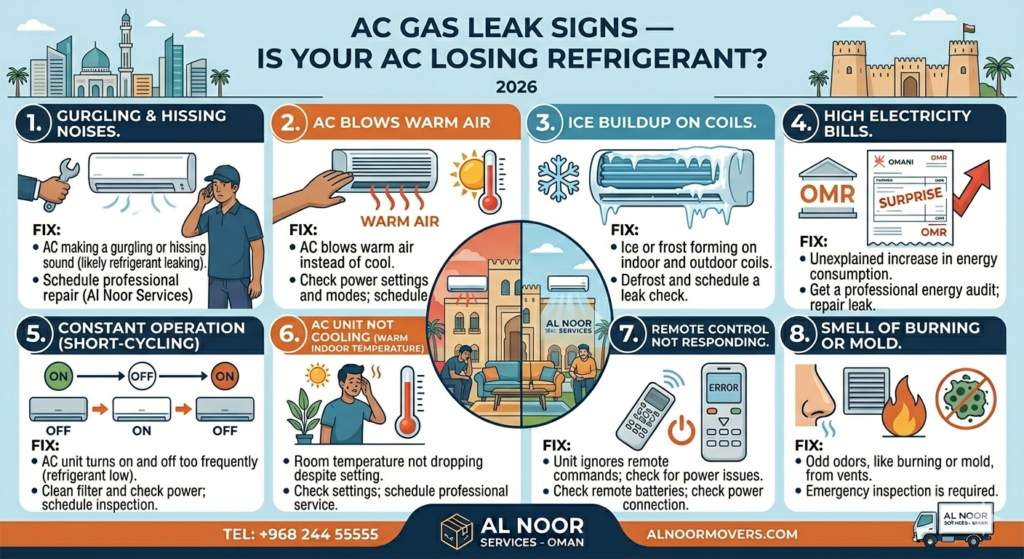
Of all the AC problems that Muscat homeowners face during Oman’s long hot season, a refrigerant gas leak is one of the most frustrating — and one of the most commonly misdiagnosed. Unlike a completely dead AC unit or a visibly blocked filter, a gas leak develops gradually and quietly, giving off warning signs that are easy to dismiss or attribute to other causes until the problem becomes serious.
In Oman’s climate, where air conditioning runs for eight to ten months of the year and sometimes around the clock, refrigerant circuits are under constant stress. Joints vibrate loose over years of continuous operation. Copper pipes develop microscopic cracks from thermal expansion and contraction. Connections corrode in humid coastal areas like Muscat’s waterfront neighbourhoods. The result is a slow refrigerant leak that steadily reduces your AC’s ability to cool — and if left unaddressed, eventually destroys the compressor entirely.
This guide covers everything you need to know about AC gas leaks in Muscat and across Oman — what refrigerant actually is, the eight most reliable warning signs that your AC needs regassing, what happens if you ignore the problem, what the regassing process involves, and when to call a certified AC technician in Oman. By the end you will know exactly how to identify a refrigerant problem early and what to do about it before it becomes an expensive repair.
WHAT IS AC REFRIGERANT AND WHY DOES IT MATTER
Before looking at the warning signs, it helps to understand what refrigerant actually does — because this makes the symptoms far easier to understand.
Refrigerant — commonly called gas in Oman, though it exists as both liquid and gas within the system — is the working fluid that makes air conditioning physically possible. It circulates continuously through a closed loop between your indoor unit and outdoor unit, absorbing heat from your room air at the indoor coil and releasing that heat outside at the condenser coil.
The critical point is that refrigerant does not get used up or consumed during normal operation. Unlike fuel in a car engine, refrigerant simply moves heat from one place to another in a continuous cycle. If your AC is low on refrigerant, there is only one explanation — it has leaked out somewhere in the system.
This distinction matters enormously. Some unscrupulous technicians in Oman will top up your refrigerant without finding and fixing the leak — taking your money for a repair that will fail again within weeks or months because the underlying leak has not been addressed. A proper AC gas repair in Muscat always involves locating and fixing the leak before adding new refrigerant.
Types of Refrigerant Used in Oman
The most common refrigerant types found in AC units across Muscat and Oman are:
R-22 (Freon) — found in older AC units installed before approximately 2010. R-22 is being phased out globally due to its environmental impact and is becoming increasingly expensive and difficult to source in Oman. If your unit uses R-22, a significant leak may make replacement of the unit more cost-effective than repeated regassing.
R-410A — the most common refrigerant in split AC units installed in Oman between 2010 and 2022. More environmentally friendly than R-22 and widely available. Cannot be used in units designed for R-22 — refrigerant types are not interchangeable.
R-32 — increasingly used in newer, more energy-efficient AC units from 2020 onwards. Better environmental profile than R-410A and slightly more efficient. Now standard in many new Daikin, Mitsubishi, and LG units sold in Oman.
R-410A and R-32 are not interchangeable. An AC technician in Oman must always use the correct refrigerant type specified on your unit’s data plate — using the wrong type will damage the compressor and void your warranty.
THE 8 WARNING SIGNS OF AN AC GAS LEAK IN MUSCAT
Sign 1 — Your AC Is Running But the Room Is Not Getting Cold Enough
The most common and most overlooked sign of an AC gas leak in Muscat.
When refrigerant levels drop, the indoor evaporator coil cannot absorb enough heat from your room air. The AC runs — the fan blows, the compressor starts — but the air coming out is noticeably less cold than it should be. The room temperature drops slowly if at all, and the unit runs almost continuously without reaching the temperature set on the remote.
Many Muscat residents assume this is simply because of the extreme summer heat — that their AC is struggling because it is 44°C outside. While outdoor temperature does affect performance, a properly charged AC unit should still cool a room effectively even in Oman’s peak summer. If your room is consistently not reaching the set temperature and your unit is not unusually old or undersized, low refrigerant is one of the most likely causes.
What makes this sign tricky: Poor cooling has multiple possible causes — a dirty filter, a blocked condenser, a faulty compressor. Low refrigerant is just one of them. The pattern of gradual decline over weeks or months rather than sudden failure is the clue that points toward a gas leak rather than a mechanical fault.
What to check yourself: Clean your filter thoroughly. If cooling improves significantly after a filter clean, the filter was the problem. If cooling remains poor with a clean filter, call a certified AC technician in Oman for a refrigerant pressure check.
Sign 2 — Ice or Frost Forming on the Indoor Unit or Copper Pipes
The most visually obvious sign — and one that many people find confusing because it seems counterintuitive.
When refrigerant levels drop below the correct operating pressure, the evaporator coil inside your indoor unit gets colder than it should — often below the freezing point of water. Moisture from the room air that condenses on the coil freezes solid rather than draining away as liquid. You end up with ice forming on the coil, the drain pan, or on the copper pipe running from the indoor unit to the outdoor unit.
This is one of the most reliable visual indicators of an AC gas leak in Muscat. It is directly caused by abnormally low refrigerant pressure causing the coil temperature to drop below freezing point.
What you will see:
- A visible coating of white frost or solid ice on the copper pipe where it enters or exits the indoor unit
- Ice visible on the indoor unit itself if you open the front panel
- Water dripping or pooling from the indoor unit as the ice periodically melts
- The indoor unit blowing slightly warmer air when the coil is heavily iced — because ice acts as insulation blocking airflow
What to do if you see ice: Switch the AC unit off immediately and allow it to defrost fully — this typically takes one to two hours with the fan running on fan-only mode. Do not continue running the AC with a frozen coil as this puts severe strain on the compressor. Once defrosted, call an AC technician in Oman for a refrigerant check before running it again.
Sign 3 — Longer Cooling Times Than Usual
A properly charged AC unit working in good condition will cool a standard room in Muscat to a comfortable temperature within fifteen to thirty minutes depending on room size and outdoor temperature. When refrigerant levels are low, the heat absorption capacity of the system is reduced — it takes significantly longer to bring the room temperature down, if it reaches the set temperature at all.
If you notice that your AC is now taking forty-five minutes to an hour to cool a room that used to reach temperature in twenty minutes — and the filter is clean — this gradual decline in cooling speed is a strong indicator of reducing refrigerant levels from a slow gas leak.
The pattern to watch for: This sign almost always develops gradually over weeks rather than overnight. If you think back and realise your AC has been getting progressively slower at cooling over the past one to two months, a refrigerant leak is the most likely explanation.
Sign 4 — Hissing or Bubbling Sounds From the Unit
The most direct acoustic sign of an AC gas leak — though not always easy to hear.
Refrigerant under pressure escaping through a crack or loose joint produces a distinctive hissing sound — similar to air escaping from a tyre. In some cases, particularly with larger leaks or leaks at liquid-phase points in the circuit, a bubbling or gurgling sound is heard instead.
These sounds may come from the indoor unit, the outdoor unit, or from the copper pipes connecting them — depending on where the leak is located.
When to listen: Turn off all background noise — TVs, fans, other appliances — and listen carefully near both the indoor and outdoor units when the AC starts up. The sounds are often most noticeable in the first few minutes of operation when the system pressurises.
Important: Not all AC sounds indicate a gas leak. A gurgling sound when the unit shuts down is normal refrigerant flow noise. A hissing sound while the unit is running and a gradual decline in cooling performance together are a much stronger indicator of a genuine leak.
Sign 5 — Higher Electricity Bills Without Increased Usage
This sign is less obvious but financially significant — and in Oman where electricity consumption is already high due to continuous AC use, an unexpected increase in your electricity bill deserves investigation.
When refrigerant levels are low, your AC compressor works much harder and runs much longer to try to achieve the set temperature. More compressor running time means more electricity consumption. The system is working at reduced efficiency — using more power to deliver less cooling.
If your electricity bill has increased noticeably over the past one to two months without a clear explanation — no change in usage hours, no new appliances, same number of occupants — and your AC is showing other signs of reduced performance, the combination strongly suggests a refrigerant issue.
How to use this sign: Compare your current month’s electricity bill with the same month in the previous year. In Oman’s climate, monthly consumption is relatively predictable by season. An unexplained increase of 15% or more alongside reduced cooling performance warrants a refrigerant pressure check.
Sign 6 — The Outdoor Unit Is Running Constantly Without Cycling Off
A normally functioning AC unit runs in cycles — the compressor starts, cools the room to near the set temperature, then the compressor cuts out while the fan maintains airflow. This cycling is normal and can be heard clearly from the outdoor unit. A well-maintained, properly charged AC unit cycles off regularly.
When refrigerant is low, the system struggles to ever reach the set temperature. The compressor never gets the signal to cut out because the target temperature is never achieved. The outdoor unit runs continuously — non-stop — hour after hour, putting enormous mechanical stress on the compressor.
How to check: Listen to your outdoor unit over a period of thirty to forty-five minutes. You should hear the compressor motor cycling on and off at intervals. If it runs continuously without stopping in a room that still does not feel fully cool, refrigerant levels or compressor efficiency should be checked by an AC technician in Oman.
Why this matters beyond comfort: A compressor running continuously under low refrigerant conditions is one of the fastest ways to destroy it. The compressor relies partly on refrigerant circulation for internal cooling and lubrication. Without adequate refrigerant, the compressor runs hot, wears rapidly, and can fail completely — turning a relatively inexpensive gas top-up into a very expensive compressor replacement.
Sign 7 — Warm Air From the Indoor Unit Even on the Lowest Setting
If your AC remote is set to 16°C or 18°C — the lowest settings — and the air coming from the indoor unit feels only mildly cool or even warm, this is a serious sign of very low refrigerant levels.
In a properly functioning AC unit, air coming from the indoor unit at a low temperature setting should feel noticeably and consistently cold — significantly colder than room temperature. If this air feels merely cool or approaches room temperature, the evaporator coil is not being adequately cooled by the refrigerant circuit and the system has likely lost a significant proportion of its refrigerant charge.
This level of performance degradation typically indicates a refrigerant level that has dropped to 30% to 50% of the correct operating charge — meaning a substantial leak has been occurring for some time. At this stage the compressor is at significant risk of damage if operation continues.
What to do: Switch the unit off and call an AC technician in Muscat immediately. Do not continue running the unit at this level of refrigerant depletion.
Sign 8 — Visible Oil Staining Near Connections or on Copper Pipes
This sign requires a closer inspection than most homeowners typically perform — but it is one of the most definitive indicators of a refrigerant leak and worth knowing about.
Refrigerant in AC systems circulates with a small amount of compressor oil. When refrigerant leaks from a joint, connection, or crack in the copper pipe, this oil escapes with it and leaves a visible residue — typically a greasy, slightly yellowish or brownish staining around the leak point.
Where to look:
- At the flare nut connections where copper pipes connect to the indoor and outdoor units
- Along the length of the copper pipe run — particularly at any bends or brackets
- At the service valve on the outdoor unit
- Around the indoor unit where the pipe enters the wall
What you will see: A greasy or oily film, sometimes with dust stuck to it, around the leak point. In some cases the staining is obvious. In others it requires cleaning the area first and checking after a few days of operation to see if oily residue reappears.
Finding oil staining at a specific location is extremely valuable information for your AC technician — it tells them exactly where to look for and repair the leak, potentially saving significant diagnostic time and cost.
WHAT HAPPENS IF YOU IGNORE AN AC GAS LEAK IN OMAN
Many Muscat homeowners notice one or two of the warning signs above but delay calling a technician — hoping the problem will resolve itself or waiting until the situation becomes impossible to ignore. In Oman’s climate, this delay is almost always costly.
Compressor Damage and Failure
The compressor is the most expensive component in your AC system — often costing OMR 150 to OMR 400 to replace depending on the unit, and sometimes more than the cost of a new budget AC entirely. The compressor relies on refrigerant circulation for internal cooling and lubrication of its moving parts. Running a compressor on severely depleted refrigerant is the equivalent of running a car engine without oil — it runs hot, wears rapidly, and eventually seizes.
A gas leak caught early costs OMR 30 to OMR 80 to repair and regas in most cases. The same leak ignored for two to three months can result in a compressor replacement costing five to ten times that amount — or a decision to replace the entire unit.
Escalating Electricity Bills
Every week of operation on low refrigerant means a compressor working harder and longer than it should. In Oman where AC electricity consumption is already a significant household cost, a refrigerant leak that has been running for two months can add OMR 20 to OMR 50 to your electricity bills over that period — often more than the cost of the repair itself.
Environmental Impact
Refrigerants — particularly older R-22 — are potent greenhouse gases with significant environmental impact when released into the atmosphere. Allowing a known refrigerant leak to continue releasing gas into the environment is both environmentally harmful and increasingly subject to regulation in Gulf countries. Prompt repair is both the responsible and the practical choice.
Cascading System Damage
Beyond the compressor, severely low refrigerant levels can damage the expansion valve, cause acid formation within the refrigerant circuit from moisture ingress through the leak point, and contaminate the system oil — all of which significantly increase the complexity and cost of the eventual repair.
WHAT THE REGASSING PROCESS INVOLVES
Understanding what a professional AC gas repair in Muscat actually involves helps you know what to expect when a technician visits and helps you verify that the job is being done properly.
Step 1 — Refrigerant Pressure Check
The technician connects a manifold gauge set to the service valve on your outdoor unit. This measures the current high-side and low-side pressures of the refrigerant circuit. These readings immediately confirm whether refrigerant levels are low and by approximately how much.
Step 2 — Leak Detection
A responsible AC technician in Oman does not simply top up the refrigerant without finding the leak. Common leak detection methods include:
- Electronic leak detector — a sensor probe passed around all joints, connections, and pipe runs that alerts when refrigerant is detected in the air
- UV dye test — a fluorescent dye is injected into the system and a UV light is used to find where it escapes
- Soap bubble test — soapy water applied to connections produces visible bubbles at a leak point
- Nitrogen pressure test — the system is pressurised with nitrogen and monitored for pressure drop
Step 3 — Leak Repair
Once the leak is located it is repaired. The repair method depends on the leak type and location. Loose flare nut connections are tightened or replaced. Cracked copper pipe sections are cut out and replaced with new pipe and properly brazed joints. Leaking valve cores are replaced. In some cases — particularly on older units — multiple small leaks are present and all must be addressed.
Step 4 — Vacuum the System
After leak repair, the system is evacuated using a vacuum pump to remove all air and moisture from the refrigerant circuit before new refrigerant is added. This step is critical and is skipped by poor-quality technicians — moisture in a refrigerant circuit causes acid formation, corrosion, and long-term system damage. A proper vacuum takes a minimum of thirty minutes for a standard split unit.
Step 5 — Refrigerant Recharge
The correct refrigerant type — matching the unit’s data plate specification exactly — is added to the system by weight or to the correct operating pressure. Overcharging is as damaging as undercharging — the system must be filled precisely.
Step 6 — Performance Test
The technician runs the unit and checks operating pressures, temperature differential between supply and return air, and all other performance parameters to confirm the system is operating correctly before completing the job.
A job that skips any of these steps — particularly leak detection, vacuuming, or precise refrigerant measurement — is not a complete or professional repair.
HOW MUCH DOES AC REGASSING COST IN MUSCAT
Typical costs for AC gas repair and regassing in Muscat in 2025 vary depending on the refrigerant type, the amount of gas required, and the complexity of the leak repair.
| Service | Typical Cost (OMR) |
|---|---|
| Refrigerant pressure check (diagnosis only) | OMR 10 – OMR 20 |
| Leak detection only | OMR 15 – OMR 30 |
| Minor leak repair (loose joint or valve) | OMR 20 – OMR 40 |
| Major leak repair (pipe replacement, brazing) | OMR 40 – OMR 100 |
| R-410A gas top-up (per unit) | OMR 25 – OMR 50 |
| R-32 gas top-up (per unit) | OMR 30 – OMR 60 |
| R-22 gas top-up (per unit, increasingly scarce) | OMR 40 – OMR 80 |
| Full leak repair and regas (typical split unit) | OMR 60 – OMR 130 |
These are indicative ranges. Your actual AC gas repair cost in Muscat will depend on the specific unit, the severity and location of the leak, and the amount of refrigerant required.
Always get a written quote before authorising any work. A reputable AC technician in Oman will provide a clear price after diagnosis — before opening the system and adding refrigerant.
HOW TO PREVENT AC GAS LEAKS IN OMAN
While some refrigerant leaks are unavoidable as a system ages, the majority of premature gas leaks in Muscat and Oman can be significantly reduced through proper installation and regular maintenance.
Ensure Proper Installation from Day One
The majority of refrigerant leaks in Oman occur at flare nut connections — the joints where copper pipes connect to the indoor and outdoor units. These joints are formed during installation by flaring the end of the copper pipe and tightening a nut against a seating surface. Poorly formed flares or overtightened or undertightened connections leak within months.
Always use a reputable, certified company for AC installation in Muscat. Poor installation is the single most common cause of early refrigerant leaks in Oman.
Annual Professional Maintenance
During a proper AC maintenance service in Muscat, a good technician checks refrigerant pressures as part of the standard inspection. This means a developing leak — one that has reduced refrigerant levels slightly but not yet caused noticeable performance problems — is caught and repaired before it causes compressor damage or performance issues.
An AC maintenance contract in Oman is the most reliable way to ensure this check happens every year without you having to remember to book it.
Protect Copper Pipes from Physical Damage
The copper pipes running between your indoor and outdoor units should be properly insulated, secured, and protected. Unprotected pipes exposed to direct sunlight degrade faster. Pipes that vibrate against walls or brackets develop fatigue cracks over time. Pipes that run through areas where they can be physically knocked or damaged are vulnerable.
During any AC service visit, ask the technician to inspect the condition of your copper pipe insulation and securing brackets — replacing degraded insulation and securing loose pipes is inexpensive and extends the life of the refrigerant circuit significantly.
Do Not Ignore Early Warning Signs
The most effective prevention is early response. A small, slow refrigerant leak caught at the first sign of slightly reduced performance — before ice forms, before the compressor runs continuously, before the room stops cooling altogether — is a simple and inexpensive repair. The same leak ignored for two to three months becomes a much more complex and expensive problem.
MUSCAT-SPECIFIC FACTORS THAT INCREASE GAS LEAK RISK
Certain conditions specific to Muscat and Oman increase the likelihood of refrigerant leaks compared to more temperate climates.
Continuous operation. AC units in Muscat often run twenty-four hours a day for five to six months of the year. This continuous operation — far beyond the design assumptions of most manufacturers — accelerates wear on all components including refrigerant circuit joints and seals.
Thermal cycling stress. The extreme temperature difference between Oman’s outdoor heat and the operating temperature of the refrigerant circuit — particularly the outdoor condenser — creates significant thermal expansion and contraction stress on copper pipes and connections over time. This is particularly pronounced during the transition periods in spring and autumn when outdoor temperatures change rapidly.
Coastal humidity in Muscat. Areas of Muscat close to the sea — Muttrah, Old Muscat, parts of Qurum and Al Ghubra — experience higher humidity levels that accelerate corrosion on copper pipes and connections, particularly where protective insulation has degraded or been damaged.
Dust and sand accumulation. While dust primarily affects AC performance through filter and coil blockage, sharp sand particles that accumulate around outdoor units and exposed pipe runs can cause abrasive wear on pipe insulation and external surfaces over time.
Power fluctuations. Voltage fluctuations from Oman’s power grid — though less common now than a decade ago — put stress on compressors and electrical components, which can indirectly affect refrigerant circuit integrity through compressor vibration and overheating.
CHOOSING THE RIGHT AC TECHNICIAN FOR GAS LEAK REPAIR IN MUSCAT
Not all AC technicians in Oman approach gas leak repair with the same level of professionalism. Here is what to look for when choosing who to call.
They diagnose before they quote. A technician who quotes you a price for regassing over the phone before seeing the unit and checking pressures is not giving you a reliable quote. A professional checks pressures first, then gives you a clear diagnosis and written quote.
They find and fix the leak before adding gas. As discussed above, adding refrigerant without fixing the leak is a temporary patch — not a repair. Ask explicitly whether the technician will locate and repair the leak before regassing. If the answer is no, find another technician.
They use the correct refrigerant type. Ask what refrigerant your unit requires and confirm the technician has the correct type available. Check the unit’s data plate yourself if possible — it shows the refrigerant type clearly. R-410A and R-32 are the most common in modern Muscat homes.
They vacuum the system before recharging. Ask whether they will vacuum the system before adding refrigerant. A good technician will confirm this without hesitation. One who seems unfamiliar with why vacuuming matters is not following proper procedure.
They are certified and insured. Working on refrigerant circuits requires certified handling in Oman. Ask whether the technician is certified for refrigerant work. Al Noor Movers sends only certified, trained AC technicians in Oman for all gas leak and regassing work.
CONCLUSION
An AC gas leak signs in Muscat is one of the more serious and potentially expensive AC problems you can face — but only if it is ignored or improperly repaired. Caught early, identified correctly, and repaired by a certified AC technician in Oman using proper procedures, a refrigerant leak is a manageable and relatively straightforward repair.
The eight warning signs in this guide — reduced cooling, ice formation, longer cooling times, hissing sounds, higher electricity bills, continuous compressor operation, warm air on low settings, and visible oil staining — give you everything you need to identify a potential gas leak early. The earlier you act, the simpler and cheaper the repair, and the lower the risk of expensive compressor damage.
If your AC is showing any of these signs in Muscat or anywhere across Oman, do not wait. Call Al Noor Movers today for a fast, professional diagnosis from a certified AC technician — we will find the leak, fix it properly, regas to the correct specification, and have your AC cooling perfectly again as quickly as possible.
📞 Suspect an AC Gas Leak in Muscat? Call Al Noor Movers Now
Certified AC technicians, same-day call-outs, all brands serviced. We find the leak, fix it properly, and regas to manufacturer specification — no shortcuts.
Visit us at: www.alnoormovers.com | Call: +968 9294 2088