One of the most common questions homeowners across Muscat, Sohar, Nizwa, and Ibra ask before starting a painting project is deceptively simple — how many coats of paint does a house actually need in Oman?
It sounds like a question with a straightforward answer. Two coats. Done. But anyone who has watched a freshly painted Muscat villa exterior look patchy and uneven after two coats, or seen an interior repaint fail to cover a previous deep colour after three coats, or noticed exterior paint on a Sohar property beginning to chalk and peel after a single hot season — knows that the real answer is considerably more nuanced than a single number.
The number of coats of paint a house needs in Oman depends on a combination of factors that are specific to the Omani environment, the surface being painted, the paint product being used, the colour being applied, and what came before. A new build villa in Muscat with fresh render requires a completely different paint system to a fifteen-year-old Qurum property being repainted over existing paint. An interior bedroom wall requires different treatment to a west-facing exterior wall in Nizwa that bakes in direct sun all afternoon.
This guide answers the coats of paint question completely and honestly — covering every surface type, every scenario, and every product stage from primer through to final topcoat, with specific guidance for Oman’s climate conditions across Muscat, Sohar, Nizwa, Ibra, and the wider Sultanate.
WHY OMAN’S CLIMATE CHANGES THE COATS OF PAINT QUESTION
Before looking at specific coat counts, understanding why Oman requires a different approach to paint systems than most other countries helps everything else make sense.
Extreme UV Degrades Paint Films Faster
Oman receives some of the world’s most intense UV radiation — particularly in the long summer months when the sun angle is high and cloud cover is minimal across most of the country. UV radiation breaks down paint binder molecules over time, causing chalking, colour fade, and film degradation. A paint film that has been UV-degraded provides less adhesion for subsequent coats — meaning paint applied over a degraded existing surface needs more preparation and more coats to achieve a lasting result than paint applied over a sound, well-maintained surface.
The practical implication is that exterior repaints in Oman — particularly in Muscat’s exposed coastal areas, in Sohar’s industrial zone, and in Nizwa and Ibra’s inland desert setting — often need more surface preparation and sometimes an additional coat compared to similar repaints in European climates where UV degradation is slower.
Alkalinity of Omani Render
Newly rendered walls in Oman — the sand and cement render that forms the substrate for almost all exterior and many interior wall surfaces — are highly alkaline when fresh. This alkalinity is a chemical enemy of oil-based and some water-based paint systems — a process called saponification occurs where the alkali in the render attacks and destroys the paint film from beneath, causing the characteristic bubbling, peeling, and powdering seen on inadequately primed new render across Muscat’s construction sites.
The high alkalinity of Omani render means that primer coats — and specifically alkali-resistant primers — are not optional extras on new construction and recent render. They are the essential first coat that determines whether everything applied above it lasts or fails prematurely.
Thermal Cycling Stresses Paint Films
Oman’s extreme daily temperature swings — from cool nights to 50°C or higher on sun-exposed exterior surfaces in summer — cause constant expansion and contraction of both the wall substrate and the paint film above it. Paint films that are too thin — too few coats applied too thinly — crack along these movement lines rather than flexing with the substrate. Adequate film build — achieved through the correct number of coats applied at the correct wet film thickness — is what gives an exterior paint system the flexibility to survive Oman’s thermal cycling.
Dust Requires More Frequent Surface Preparation
Oman’s dusty environment — particularly pronounced in Sohar’s industrial area, in Nizwa and Ibra’s proximity to the desert, and across Muscat during shamal wind events — means exterior painted surfaces accumulate dust and sand contamination faster than in cleaner climates. Before any repaint, these surfaces require thorough cleaning. Dust-contaminated surfaces reduce paint adhesion — meaning a paint job that skips proper pre-paint cleaning effectively throws away the investment in premium paint products by applying them to a compromised substrate.
THE COMPLETE PAINT SYSTEM — UNDERSTANDING WHAT COUNTS AS A COAT
A common source of confusion in the coats of paint question is understanding what actually constitutes a coat in a complete paint system. Many homeowners think of a coat as simply paint applied to a wall — but a professional paint system has multiple distinct layers, each serving a specific function.
The Primer — Layer One
The primer is the first coat applied to any properly prepared surface. Primer serves several critical functions that no topcoat product can replace — it seals porous surfaces to reduce absorption, provides a chemically compatible base for the topcoat to adhere to, resists the alkalinity of fresh render, and in some cases provides a barrier against staining or moisture transmission.
Primer is always a separate layer from the topcoat. A homeowner or contractor who skips primer and applies two topcoats instead is not applying a two-coat system — they are applying a compromised one-stage system that will almost certainly fail earlier than a properly primed surface.
In Oman’s conditions, the primer stage is arguably the most important single coat in the entire paint system — because without it, every topcoat layer above is working on an inadequate foundation.
The Undercoat — Layer Two (Where Required)
An undercoat — sometimes called a mid-coat or build coat — sits between the primer and the final topcoat on certain surfaces and applications. Undercoat provides additional film build, improves the opacity of the final topcoat colour, and creates a uniform base that reduces the number of expensive topcoat layers needed to achieve a solid, even colour.
Not every paint system requires a separate undercoat — modern high-build primers and self-undercoating topcoats eliminate this stage in some applications. But on surfaces where significant colour change is involved, or where a deep colour is being applied over a light one, an undercoat layer significantly improves the efficiency and quality of the finish.
The Topcoat — Layers Two, Three, or More
The topcoat is the visible finish layer — the colour that the room or exterior wall actually shows. Topcoats provide colour, sheen, washability for interiors, and weather resistance for exteriors. The number of topcoat layers needed depends on the paint opacity, the colour being applied, the surface condition, and the finish requirement.
Most professional painting specifications in Oman call for a minimum of two topcoat layers on properly primed and prepared surfaces — and three or more in specific circumstances covered below.
HOW MANY COATS FOR EACH SCENARIO IN OMAN
New Build Interior Walls — Fresh Render in Muscat
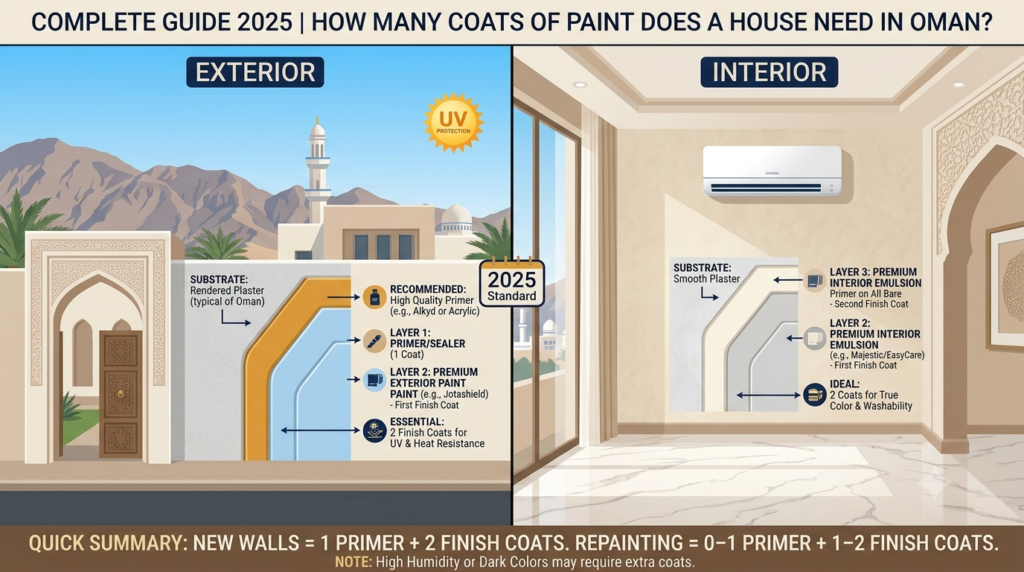
Total coats: 1 primer + 2 topcoats = minimum 3 coats
New render in Muscat villas and apartments needs specific treatment. Fresh Omani render is highly alkaline — particularly in the first three to six months after application — and must not be painted directly with standard interior emulsion without priming.
Coat 1 — Alkali-Resistant Primer
Apply one coat of alkali-resistant primer — Jotun Jotaplast AR, Dulux Weathershield Primer, or equivalent — to the entire fresh render surface. This primer neutralises the alkalinity, seals the porous render, and provides a compatible base for the topcoat. Allow to dry completely — typically two to four hours in Muscat’s warm conditions.
Coat 2 — First Topcoat
Apply the first coat of your chosen interior emulsion — Jotun Lady Supreme, Dulux EasyCare, or equivalent premium interior product. The first topcoat on fresh primed render will typically not achieve full coverage in one coat — the render texture and primer absorption means some variation in coverage is normal.
Coat 3 — Second Topcoat
Apply the second coat of interior emulsion after the first coat has dried fully — in Oman’s warm conditions typically four to six hours, though overnight drying between coats is better practice. The second topcoat achieves solid, even coverage over the primed render and creates the final finish.
When a fourth coat is needed: On very rough or texture-variable fresh render, a third topcoat may be needed to achieve a perfectly even colour across the entire wall surface. On smooth, well-finished render with a good primer coat, two topcoats are usually sufficient.
New Build Exterior Walls — Fresh Render in Muscat
Total coats: 1 alkali-resistant primer + 2 exterior topcoats = minimum 3 coats
The exterior new render paint system in Oman requires more robust products than the interior equivalent but follows the same three-coat logic — prime, undercoat if required, and two topcoats minimum.
Coat 1 — Alkali-Resistant Exterior Primer
Jotun Jotaplast Exterior, Dulux Weathershield Stabilising Primer, or equivalent. This is non-negotiable on fresh Omani render — the alkalinity of new cement render will destroy unprimed exterior paint within one season regardless of how premium the topcoat product is. Allow to cure fully before proceeding — typically twenty-four hours in Muscat’s conditions.
Coat 2 — First Exterior Topcoat
Apply the first coat of your chosen exterior paint — Jotashield Extreme, Dulux Weathershield Maximum, or equivalent Gulf-rated exterior product. The first topcoat on primed render builds the film and begins to develop the colour.
Coat 3 — Second Exterior Topcoat
The second exterior topcoat achieves full film build and solid colour coverage. Two topcoat layers of a quality exterior product over a properly primed Omani exterior wall is the minimum specification for acceptable durability.
When a fourth coat is needed: For deep or saturated exterior colours on textured render, three topcoat layers are recommended to achieve full coverage without thin spots. For west-facing walls in Muscat and Sohar that receive the most intense afternoon sun, a three-coat topcoat system provides a meaningfully thicker film that better resists the accelerated UV degradation on these highly exposed surfaces.
Interior Repaint — Existing Paint in Good Condition
Total coats: 0 primer (usually) + 2 topcoats = 2 coats minimum
When repainting an interior room in a Muscat home or apartment where the existing paint is in good condition — sound adhesion, no flaking or bubbling, clean surface — a full primer coat is not always necessary. The existing paint provides an adequate substrate for new topcoat if properly prepared.
Surface preparation — cleaning with a mild detergent solution to remove cooking grease, dust, and marks, followed by light sanding of any rough areas and filling any minor holes or cracks — is the essential first step and must be done regardless of coat count.
Coat 1 — First Topcoat
The first interior topcoat over a prepared, clean existing paint surface. In most cases with a good quality product, coverage will be partial but developing in this first coat.
Coat 2 — Second Topcoat
The second coat achieves full, even coverage over the existing paint and creates the final finish.
When three coats are needed: Painting a deep, dark colour over a light existing wall requires three topcoats to achieve solid coverage — the light colour bleeding through is very common when going from light to dark in one or two coats. Painting a light colour over an existing deep colour — white over dark red, cream over deep grey — almost always requires three coats and sometimes four. In these situations applying a tinted primer matched to your new colour between the old colour and the topcoats significantly reduces the number of topcoats needed.
Interior Repaint — Damaged or Poor Condition Existing Paint
Total coats: 1 stabilising primer + 2 topcoats = minimum 3 coats
Interior walls with flaking, powdering, bubbling, or poorly adhering existing paint in Muscat homes — common in older properties in Ruwi, Muttrah, and older Al Khuwair developments — require a stabilising primer coat before any topcoat can be applied effectively.
Surface preparation is more extensive for damaged surfaces — loose and flaking paint must be removed completely, surfaces washed down, cracks and holes filled with appropriate filler and sanded smooth, and any damp areas treated if moisture is the cause of the failure.
Coat 1 — Stabilising Primer
A penetrating stabilising primer consolidates the existing paint surface, seals powdering areas, and provides a uniform substrate for the topcoat. Jotun Primer and Dulux Stabilising Primer are suitable products widely available in Muscat.
Coat 2 — First Topcoat
First interior emulsion coat over the primed, stabilised surface.
Coat 3 — Second Topcoat
Second interior emulsion coat achieving final coverage and finish.
Exterior Repaint — Existing Paint in Good Condition
Total coats: 0 or 1 primer + 2 topcoats = 2 to 3 coats
For an exterior repaint in Muscat where the existing exterior paint is in good condition — sound adhesion, no chalking, clean surface — a full primer may not be needed if the existing paint is of the same type as the new product. However Oman’s UV environment means that most exterior paint surfaces show at least some degree of chalking after two to three years — and chalked surfaces require a stabilising treatment before repainting.
Chalk test: Run your hand firmly across the exterior wall. If a white powder transfers to your hand, the surface is chalking and needs treatment before repainting.
If chalking is present: Apply one coat of Jotun Jotaplast stabilising primer or Dulux Weathershield Stabilising Primer before the topcoats. This consolidates the chalked layer and gives the topcoat a sound surface to adhere to.
Coat 1 — First Exterior Topcoat
First coat of Jotashield, Weathershield, or equivalent exterior product.
Coat 2 — Second Exterior Topcoat
Second coat achieving full film build and colour coverage.
When three topcoats are needed: Deep colour changes on exterior surfaces, west and south-facing walls receiving maximum sun exposure, and properties in particularly dusty areas of Sohar, Nizwa, and Ibra where surface abrasion has thinned the existing paint film all benefit from three exterior topcoats.
Exterior Repaint — Failing or Damaged Existing Paint
Total coats: Surface treatment + 1 primer + 2 to 3 topcoats = 3 to 4 coats minimum
For exterior surfaces in Muscat, Sohar, Nizwa, or Ibra where the existing paint has significantly failed — extensive chalking, flaking, peeling sections, or paint applied without primer on original construction — the preparation and coat count is more extensive.
Surface preparation is the most labour-intensive part of this scenario. Loose paint must be removed by scraping or pressure washing. Bare render patches must be repaired and allowed to cure. Any oil, dirt, or contamination must be washed off completely. Cracks and surface imperfections must be filled.
Coat 1 — Stabilising Primer on Existing Paint / Alkali-Resistant Primer on Bare Patches
Different primers may be needed on different areas of the same wall — alkali-resistant primer on bare render patches exposed by paint removal, stabilising primer on the remaining existing paint areas. This is a detail that shortcuts in the preparation stage typically miss — and it is why repaint jobs done by experienced Muscat professional painters last significantly longer than those done without proper specification.
Coat 2 — First Exterior Topcoat
First coat of quality exterior product over the primed surface.
Coat 3 — Second Exterior Topcoat
Second coat building the film and achieving coverage.
Coat 4 — Third Exterior Topcoat (Recommended)
For severely degraded surfaces that have required extensive preparation, a third topcoat is strongly recommended to build adequate film thickness for durability in Oman’s conditions. The investment in a third topcoat adds a relatively small material cost — approximately OMR 2 to OMR 5 per square metre in additional paint — against the far larger cost of repainting again in three years instead of seven.
Bathroom and Kitchen Interior Walls
Total coats: 1 moisture-resistant primer + 2 topcoats = 3 coats
Bathrooms and kitchens in Muscat homes present specific painting challenges — moisture, steam, cooking fumes, and in some older properties genuine dampness from inadequate waterproofing. These surfaces always require specialist treatment.
Coat 1 — Moisture-Resistant or Sealing Primer
Jotun Lady Anti-Mould primer or Dulux Bathroom Primer applied to all bathroom and kitchen walls. This primer seals the surface against moisture penetration and provides a biocide base that helps prevent mould growth behind the topcoat.
Coat 2 — First Anti-Mould Topcoat
Jotun Lady Anti-Mould, Dulux Bathroom Plus, or equivalent moisture and mould-resistant interior product.
Coat 3 — Second Anti-Mould Topcoat
Second coat achieving full coverage and a surface smooth enough to clean easily. The semi-sheen or eggshell finish of bathroom-specific products helps resist moisture absorption into the paint film.
Ceilings
Total coats: 1 primer (new build or damaged) + 2 topcoats = 2 to 3 coats
Ceilings are often painted with fewer coats than walls — but this is a false economy that results in uneven sheen and inadequate coverage particularly under the directional lighting common in Omani homes.
New build ceilings: Follow the same system as new build interior walls — alkali-resistant primer followed by two coats of ceiling white or your chosen ceiling colour.
Repaint ceilings in good condition: Two coats of ceiling paint over cleaned, prepared surface. Ceiling white with a dead-flat finish shows every imperfection and patchy coverage more visibly than wall paint because of the directional light hitting it — two thorough coats are essential.
Ceiling with water staining from AC leaks: This is a very common situation in Muscat apartments where AC drainage has leaked into the ceiling at some point. Water stains bleed through standard ceiling paint regardless of how many coats are applied — a stain-blocking primer must be applied over the stained area before any topcoat is applied, or the stain will return through the finished coat within weeks.
Woodwork — Doors, Frames, and Skirting Boards
Total coats: 1 wood primer + 1 undercoat + 2 gloss topcoats = 4 coats
Woodwork in Omani homes — interior and exterior doors, door frames, skirting boards, window frames — requires its own complete paint system separate from the wall painting.
Coat 1 — Wood Primer
All bare or stripped wood surfaces require a wood-specific primer to seal the grain, prevent resin bleed on hardwoods, and provide adhesion for subsequent coats.
Coat 2 — Undercoat
An oil-based or water-based undercoat applied to the primed wood. The undercoat builds film thickness and creates a uniform grey or white base that prevents the final gloss topcoat from appearing thin or showing variation.
Coat 3 — First Gloss Topcoat
The first coat of your chosen gloss or semi-gloss finish. This coat will not look perfect — minor brush marks and variations in sheen are normal at this stage.
Coat 4 — Second Gloss Topcoat
Light sanding of the first gloss coat when dry — with fine sandpaper — followed by the second gloss coat. The sanding between coats removes dust particles and brush marks, allowing the second gloss coat to achieve a smooth, even finish.
Why four coats on woodwork matter in Oman: Exterior woodwork in Oman’s climate — front doors, window frames, external shutters — is subjected to intense UV, extreme heat, and the thermal movement that comes with temperature swings. An inadequate film build on exterior woodwork in Muscat causes cracking, peeling, and moisture ingress that damages the wood beneath. Four coats of properly applied woodwork paint delivers the film thickness that protects against these conditions.
Metal Surfaces — Gates, Railings, and Roof Elements
Total coats: 1 rust-inhibiting primer + 2 topcoats = 3 coats minimum
Metal surfaces on Omani properties — security gates, balcony railings, roof metalwork, and air conditioning brackets — are particularly vulnerable to corrosion in the coastal areas of Muscat and Sohar where salt-laden marine air accelerates rust formation dramatically.
Coat 1 — Rust-Inhibiting Metal Primer
All metal surfaces must be wire-brushed or sanded to remove existing rust and loose paint before priming. Zinc phosphate or red oxide primer applied to clean, bare metal provides the corrosion-inhibiting base that prevents rust developing under the topcoat. Skipping the metal primer on Omani coastal properties means rust breaks through the topcoat within one season.
Coat 2 — First Metal Topcoat
Oil-based or water-based metal enamel applied over the primed surface.
Coat 3 — Second Metal Topcoat
Second coat achieving full coverage and the smooth, durable finish required for metal surfaces.
In coastal Muscat areas: Consider a fourth coat on metal surfaces — particularly exposed gate and railing ironwork — in highly salt-exposed locations like Al Mouj, Shatti Al Qurum, and Muttrah waterfront properties. The additional coat investment is minimal against the cost of stripping and repainting rusted ironwork every two to three years.
THE ROLE OF FILM THICKNESS — WHY TWO THIN COATS ARE WORSE THAN TWO PROPER COATS
Understanding film thickness — how much paint is actually deposited on the surface per coat — is as important as understanding coat count. Two coats applied too thinly deliver less protection than two properly applied full-thickness coats.
What Affects Film Thickness
Application method. Roller application typically deposits a thicker, more even film than brush application. Airless spray application deposits the thinnest film per pass — excellent for speed and even distribution but requiring more passes to achieve adequate thickness. Most professional painting in Muscat uses rollers for walls and brushes for edges and woodwork.
Paint viscosity and dilution. Paint diluted heavily with water to “make it go further” produces thinner film coats that provide less protection per coat. In Oman’s conditions, diluting exterior paint beyond the manufacturer’s recommended maximum reduction directly reduces durability. Never dilute exterior paint by more than five to ten percent in Oman — the manufacturer’s specification is set for standard conditions, and Oman’s demands argue for less dilution rather than more.
Surface absorption. Highly porous surfaces — fresh render, bare plaster — absorb the first coat aggressively, resulting in a thinner effective film on the surface than on a sealed, primed surface. This is another reason why priming is essential — the primer seals the porous surface so that topcoat products deposit their full film thickness rather than being absorbed into the substrate.
COMMON PAINTING MISTAKES IN OMAN THAT REDUCE COAT EFFECTIVENESS
These are the most frequently seen shortcuts and errors on Omani painting projects — understanding them helps you identify whether a painting contractor is doing the job properly.
Skipping primer on new render. The single most common and most costly mistake on new build and recently rendered properties across Muscat. Always ask for written confirmation that an alkali-resistant primer is in the painting specification for any new or recently rendered surface.
Applying the second coat before the first is dry. In Oman’s summer heat, paint surfaces can feel dry to the touch within thirty to sixty minutes — but this surface dryness does not mean the coat has cured sufficiently for recoating. Applying the second coat before the first has properly cured traps solvents, reduces adhesion between coats, and can cause the paint system to wrinkle or peel. Minimum recoat times specified by the manufacturer should be followed even when the surface feels dry.
Painting exterior surfaces in peak midday heat. Exterior painting in Muscat and across Oman between 10am and 4pm during summer months — when wall surface temperatures can reach 55°C to 65°C — causes rapid solvent evaporation that prevents proper film formation. Exterior painting in Oman should be done in the early morning before 9am or in the late afternoon after 4pm. This is not always practical with painting contractors under pressure to complete quickly — insist on it.
Insufficient surface cleaning before repainting. Muscat’s dusty environment means exterior walls accumulate significant contamination between paint cycles. Painting over a dusty, dirty exterior wall with new paint is like applying new paint to the dust rather than the wall — adhesion is severely compromised. Pressure washing or thorough hand washing before any repaint is essential.
Using interior paint on exterior surfaces. This happens more often than it should in Oman — a contractor using cheaper interior paint on exterior surfaces to increase margin. Interior paint on an exterior wall in Muscat will fail within one summer. Always specify the brand and product reference for exterior surfaces in writing before any painting project begins.
Not applying enough coats on colour changes. Changing from a light to a dark colour or vice versa in an Omani home requires more coats than a same-colour refresh — but contractors under time pressure sometimes apply only two coats and declare the job done despite patchy coverage showing through. Insist on seeing the wall in full daylight, preferably with sunlight on it, before accepting the finish as complete.
QUICK REFERENCE GUIDE — COATS OF PAINT FOR EVERY SURFACE IN OMAN
Use this table as a quick reference for your specific painting project across Muscat, Sohar, Nizwa, or Ibra.
| Surface | Scenario | Primer Coats | Topcoats | Total Coats |
|---|---|---|---|---|
| Interior wall | New render | 1 alkali-resistant | 2 | 3 |
| Interior wall | Repaint — good condition | 0 | 2 | 2 |
| Interior wall | Repaint — damaged paint | 1 stabilising | 2 | 3 |
| Interior wall | Light to dark colour change | 1 tinted primer | 2–3 | 3–4 |
| Interior wall | Dark to light colour change | 1 tinted primer | 3 | 4 |
| Bathroom or kitchen wall | Any | 1 moisture-resistant | 2 | 3 |
| Ceiling | New build | 1 | 2 | 3 |
| Ceiling | Repaint — good condition | 0 | 2 | 2 |
| Ceiling | With water staining | 1 stain-blocking | 2 | 3 |
| Exterior wall | New render | 1 alkali-resistant | 2 | 3 |
| Exterior wall | Repaint — good condition | 0–1 stabilising | 2 | 2–3 |
| Exterior wall | Repaint — failing paint | 1 stabilising | 2–3 | 3–4 |
| Exterior wall | West or south facing — Oman | 1 | 3 | 4 |
| Woodwork — interior | New or stripped | 1 wood primer + 1 undercoat | 2 gloss | 4 |
| Woodwork — exterior | New or stripped | 1 wood primer + 1 undercoat | 2 gloss | 4 |
| Metal — gates and railings | New or stripped | 1 rust-inhibiting | 2 | 3 |
| Metal — coastal Muscat | New or stripped | 1 rust-inhibiting | 3 | 4 |
HOW LONG DOES EACH COAT TAKE TO DRY IN OMAN
Drying time between coats is affected by Oman’s climate — specifically the high temperatures and low humidity of the interior environment and the extreme heat of exterior surfaces in summer.
Interior paint drying times in Muscat:
Touch dry: 30 to 60 minutes in air-conditioned interior
Recoat time: 2 to 4 hours minimum
Full cure: 7 to 14 days
Exterior paint drying times in Muscat:
Touch dry: 30 to 45 minutes in summer heat
Recoat time: 4 to 6 hours minimum — allow overnight between coats for best results
Full cure: 14 to 28 days
Important: Touch dry and recoat-ready are different states. Paint that feels dry to the touch may not have adequately cured for the next coat to adhere properly. Following minimum recoat times from the paint manufacturer’s datasheet — not just waiting until the surface feels dry — is particularly important in Oman where the surface dries fast but the full coat needs time to develop its film properties.
HOW MUCH PAINT DO YOU NEED — CALCULATING QUANTITIES FOR AN OMAN HOME
Once you know how many coats your Omani home needs, calculating how much paint to buy is the practical next step.
Coverage Rates for Common Products in Oman
Interior emulsion (Jotun Lady, Dulux EasyCare):
Approximately 10 to 12 square metres per litre per coat on a smooth, primed surface. On rough or porous Omani render, allow 8 to 10 square metres per litre.
Exterior paint (Jotashield, Dulux Weathershield):
Approximately 8 to 10 square metres per litre per coat on smooth render. On rough textured render — common on older Muscat villas — allow 6 to 8 square metres per litre.
Primer (interior or exterior):
Approximately 8 to 10 square metres per litre. Porous new render can absorb significantly more primer than this — allow a generous quantity for first-time priming of fresh render.
Simple Calculation for a Muscat Villa Room
For a standard bedroom in a Muscat villa — approximately 4 metres x 4 metres with 3-metre ceilings:
Wall area: (4 + 4 + 4 + 4) x 3 = 48 square metres
Less doors and windows: approximately 8 square metres
Net wall area: approximately 40 square metres
For two topcoats at 10 square metres per litre: 40 x 2 ÷ 10 = 8 litres of topcoat
For one primer coat at 8 square metres per litre: 40 ÷ 8 = 5 litres of primer
Total for one bedroom: approximately 13 litres of paint products
Always add ten to fifteen percent to your calculation for wastage, touch-ups, and variation in surface absorption.
DOES MORE COATS ALWAYS MEAN BETTER RESULTS
The answer is no — beyond a certain point, adding more coats of paint does not improve the result and can actually create problems.
Over-application of paint — too many coats built up over multiple repaints — creates a thick, layered paint system that is prone to cracking along its internal boundaries. Older properties in Ruwi, Muttrah, and established Muscat suburbs that have been repainted many times without stripping can develop this “alligatoring” pattern where the thick paint film cracks in a regular geometric pattern across the surface.
The solution for properties with excessive paint build-up is periodic stripping back to the bare surface — removing all paint layers — before applying a fresh complete system from primer. This is recommended on Omani exterior walls when the total paint depth becomes visually significant or when multiple repaints begin to obscure architectural detail.
The right approach is not maximum coats — it is the correct number of coats of the right products applied in the right sequence to a properly prepared surface. A three-coat system applied correctly — alkali-resistant primer, two full topcoats of premium exterior paint — will outlast a five-coat system applied without primer over inadequately prepared surfaces in Oman’s conditions every time.
WORKING WITH A PROFESSIONAL PAINTING COMPANY IN OMAN
The coats of paint question ultimately demonstrates why professional painting in Muscat and across Oman is worth the investment. The decisions about how many coats, which primer, which products, and how to sequence the application are technical judgements that require knowledge of paint chemistry, surface science, and Oman’s specific climate challenges.
Al Noor Movers provides professional house painting services across Muscat, Sohar, Nizwa, Ibra, and Oman — with a team that understands exactly how many coats of paint every surface in an Omani home needs and why. We specify the correct primer for every surface type, apply the correct number of topcoats for the specific scenario, follow proper drying times between coats, and deliver a finish that lasts in Oman’s demanding climate.
Every Al Noor Movers painting project begins with a proper surface assessment — identifying the substrate type, existing paint condition, and any specific issues — before specifying the correct paint system and coat count. This is the difference between a paint job that looks good for five years and one that begins to fail within the first summer.
CONCLUSION
How many coats of paint does a house need in Oman? The honest answer is a minimum of three coats on almost every surface — primer plus two topcoats — and up to four or five coats in specific scenarios involving new render, failing existing paint, difficult colour changes, or highly exposed exterior surfaces in Muscat’s coastal areas or Oman’s inland desert cities.
The primer coat is never optional. The minimum of two topcoats is the standard, not the maximum. Colour changes, surface condition, and exposure severity all determine when additional coats are needed. And the quality of each coat — proper application, adequate film thickness, correct drying time — matters as much as the number of coats in determining how long your paint job lasts in Oman’s demanding environment.
Use the quick reference table in this guide to identify the correct coat count for every surface in your Omani home. And when you are ready to start your painting project in Muscat or across Oman, Al Noor Movers is here to deliver the professional result that the right number of coats, properly applied, makes possible.
Ready to Paint Your Home in Muscat or Oman the Right Way?
Al Noor Movers provides professional house painting across Muscat, Sohar, Nizwa, Ibra, and Oman. Correct primer, correct coats, correct products — guaranteed finish.
Visit us at: www.alnoormovers.com | Call: +968 9294 2088 Get a Free Painting Quote